
OP Jindal Online M.Sc Artificial Intelligence & Finance 2026: Fees, Eligibility & Helpline Number

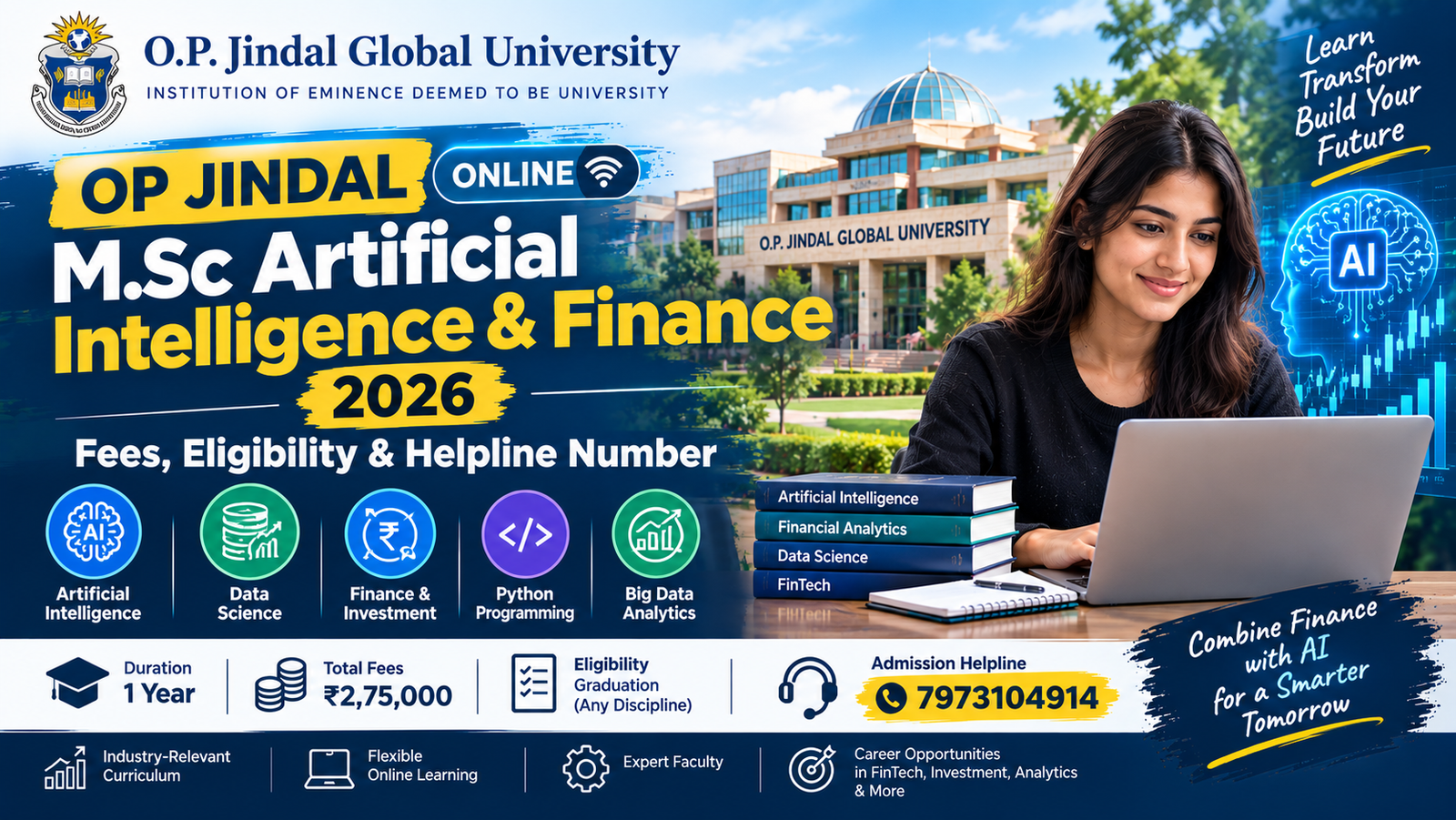
Artificial Intelligence is rapidly transforming the financial sector. From algorithmic trading and portfolio management to fraud detection, risk analysis, digital banking and financial forecasting, AI is becoming an important part of modern finance. This changing industry landscape has created a growing demand for professionals who understand both financial concepts and artificial intelligence.
The OP Jindal Online M.Sc Artificial Intelligence & Finance 2026 is designed for graduates and professionals who want to develop expertise at the intersection of finance, artificial intelligence, data analytics and emerging financial technologies.
The programme is offered by the Jindal School of Banking & Finance (JSBF) at O.P. Jindal Global University. The current 2026 programme information lists it as a 12-month online master’s programme, with 66 credits, a total fee of ₹2,75,000, and a batch start date of 1 September 2026.
The programme combines financial management, financial markets, Python programming, financial data analytics, machine learning applications, fintech, digital banking, portfolio management, algorithmic trading, blockchain and Agentic AI.
For students and working professionals searching for OP Jindal Online M.Sc Artificial Intelligence & Finance fees, eligibility, syllabus, admission process, career scope and helpline number, this detailed guide covers the important information.
OP Jindal Online M.Sc AI & Finance 2026 – Highlights
| Particular | Details |
|---|---|
| Programme | M.Sc Artificial Intelligence & Finance |
| University | O.P. Jindal Global University |
| School | Jindal School of Banking & Finance |
| Mode | Online |
| Duration | 12 Months |
| Batch Start | 1 September 2026 |
| Total Credits | 66 |
| Total Tuition Fee | ₹2,75,000 |
| Minimum Eligibility | Undergraduate degree with 50% marks |
| Lower Marks Route | JSAT examination may be required |
| Major Areas | AI, Finance, FinTech, Data Analytics, Machine Learning |
| Admission Helpline | 7973104914 |
The programme is listed among JGU’s online postgraduate offerings and is positioned at the intersection of technology, finance and digital transformation.
What is OP Jindal Online M.Sc Artificial Intelligence & Finance?
The OP Jindal Online M.Sc Artificial Intelligence & Finance is a postgraduate programme that combines financial knowledge with artificial intelligence and emerging technologies.
Traditional finance programmes generally focus on areas such as financial management, accounting, investment, markets and corporate finance. The AI & Finance programme adds technological capabilities such as Python, financial data analytics, natural language processing, Agentic AI, algorithmic trading and blockchain.
This interdisciplinary approach is designed to prepare students for a financial industry where technology and data are becoming increasingly important.
The programme focuses on areas including:
- Artificial Intelligence
- Financial Analytics
- Machine Learning
- Python Programming
- Financial Markets
- FinTech
- Digital Banking
- Algorithmic Trading
- Portfolio Management
- Robo-Advisory
- Blockchain
- Digital Currency
- Technology Risk
- AI Governance
- Financial Data Analysis
The programme also includes real-world projects, case studies and practical applications related to financial markets and technology.
Why Choose M.Sc Artificial Intelligence & Finance in 2026?
The finance industry is changing quickly because of artificial intelligence, automation and data-driven decision-making.
Banks, investment firms, fintech companies and financial institutions are increasingly using technology for:
- Risk assessment
- Fraud detection
- Credit analysis
- Portfolio management
- Financial forecasting
- Customer analytics
- Algorithmic trading
- Automated investment services
- Digital banking
- Compliance
- Financial research
This creates opportunities for professionals who can understand both the financial problem and the technology used to solve it.
A professional who understands finance but also knows how AI, machine learning and financial data analytics work can potentially explore a broader range of career opportunities.
The OP Jindal programme specifically focuses on applying AI and data science to financial markets, risk analysis, algorithmic trading and fintech.
OP Jindal Online M.Sc AI & Finance Fees 2026
The current programme listing shows the total tuition fee as:
₹2,75,000
The fee structure currently listed for the 2026 programme is:
| Fee Component | Amount |
|---|---|
| Registration Amount | ₹25,000 |
| Instalment 1 | ₹1,25,000 |
| Instalment 2 | ₹1,25,000 |
| Total | ₹2,75,000 |
The registration amount is listed as payable upon acceptance of the offer, while the first instalment is due before batch commencement and the second instalment is listed for 15 January 2027.
Students should confirm the applicable payment schedule at the time of admission because fee deadlines and admission policies may be updated for different intakes.
OP Jindal Online M.Sc AI & Finance Eligibility 2026
The eligibility criteria are designed for graduates who want to develop expertise in both finance and artificial intelligence.
Basic Eligibility
Applicants should have:
- An undergraduate degree or equivalent qualification
- At least 50% marks in graduation
Candidates with less than 50% marks may be required to appear for the JSAT examination according to the current programme information.
This makes the programme suitable for graduates from a variety of disciplines who are interested in developing skills in finance and technology.
Can Students From Different Backgrounds Apply?
Yes. The programme is designed for graduates and professionals interested in combining financial knowledge with AI, machine learning and analytics.
Students may come from backgrounds such as:
- Commerce
- Finance
- Economics
- Business Administration
- Mathematics
- Statistics
- Computer Science
- Information Technology
- Engineering
- Management
- Other related undergraduate disciplines
The key requirement is meeting the prescribed graduation eligibility criteria and demonstrating an interest in the programme.
OP Jindal Online M.Sc AI & Finance Duration
The programme has a duration of:
12 Months
The course is divided into four academic terms and carries a total of 66 credits. The current programme listing gives the 2026 batch start as 1 September 2026.
The one-year structure makes it particularly relevant for graduates and working professionals who want to acquire specialised postgraduate knowledge within a relatively short period.
OP Jindal Online M.Sc AI & Finance Syllabus 2026
The curriculum combines finance fundamentals with artificial intelligence, data analytics and emerging technologies.
The programme consists of four terms.
Term 1 – Finance & Technical Foundations
The first term establishes the foundation in finance, statistics and programming.
Financial Management
Students learn the fundamentals of financial decision-making and management.
Important areas include:
- Financial planning
- Capital decisions
- Financial analysis
- Business finance
- Financial decision-making
Financial Mathematics and Statistics
This subject introduces mathematical and statistical concepts relevant to finance.
Students can develop an understanding of:
- Financial calculations
- Probability
- Statistical analysis
- Quantitative decision-making
Financial Markets and Instruments
Students learn about financial markets and instruments and how they operate within the broader financial system.
Python Programming for Financial Applications
Python is increasingly important in financial analytics and AI.
Students learn how programming can be applied to financial problems and data.
The first term carries 16 credits.
Term 2 – Financial Data & Risk
The second term moves toward financial data analysis and technology risk.
Financial Data Analytics and Time Series
This subject focuses on analysing financial data over time.
Time-series analysis can be useful for:
- Market analysis
- Financial forecasting
- Trend identification
- Investment research
- Economic analysis
International Corporate Social Responsibility and Ethics
Students explore ethical and responsible business practices within an international context.
Technology Risk Management
As financial organisations increasingly rely on technology, technology-related risks have become important.
Students can explore areas involving:
- Technology risk
- Operational risk
- Digital systems
- Risk controls
- Financial technology
Global Economy and Geopolitical Risk
This subject connects financial decisions with global economic and geopolitical developments.
The second term carries 18 credits.
Term 3 – AI, FinTech & Investment
The third term introduces several important applications of technology in modern finance.
Natural Language Processing for Financial Markets
Natural Language Processing, or NLP, enables computer systems to analyse and process human language.
In finance, NLP can be applied to:
- Financial news analysis
- Market sentiment
- Company reports
- Research documents
- Financial communications
FinTech Innovations and Digital Banking
Students explore technologies transforming banking and financial services.
Topics can include:
- Digital banking
- FinTech platforms
- Digital payments
- Financial automation
- Emerging financial technologies
Portfolio Management and Robo-Advisory
This subject combines investment management with technology.
Students can learn about:
- Portfolio construction
- Investment decisions
- Risk and return
- Automated advisory
- Robo-advisory systems
Corporate Governance and Compliance
Students also develop an understanding of governance and regulatory considerations within financial organisations.
The third term carries 16 credits.
Term 4 – Advanced AI & Financial Innovation
The final term focuses on advanced applications of artificial intelligence and financial technology.
Theories and Applications of Agentic AI
Agentic AI represents a newer direction in artificial intelligence, involving systems capable of performing tasks and taking actions based on defined objectives.
Understanding such technologies can be valuable for students interested in the future of intelligent financial systems.
Algorithmic Trading and Quantitative Strategies
Students explore how algorithms and quantitative methods can be applied to financial markets.
Potential applications include:
- Market analysis
- Trading strategies
- Quantitative research
- Automated trading
- Financial modelling
Blockchain and Digital Currency
Students learn about blockchain technology and its relevance to digital financial systems.
Capstone Project
The programme concludes with a capstone project that allows students to apply their learning to a practical or research-oriented problem.
The fourth term carries 16 credits.
OP Jindal Online M.Sc AI & Finance Total Credits
The programme carries:
66 Credits
The credit structure is:
| Term | Credits |
|---|---|
| Term 1 | 16 |
| Term 2 | 18 |
| Term 3 | 16 |
| Term 4 | 16 |
| Total | 66 |
This structure combines finance, technology, analytics and practical learning throughout the programme.
Key Skills You Can Develop
One of the main advantages of an interdisciplinary programme is that students can develop both domain knowledge and technical capabilities.
1. Financial Analysis
Students develop an understanding of financial management, markets and financial instruments.
2. Python Programming
Python can be used for financial analysis, data processing and automation.
3. Financial Data Analytics
Students learn how data can be analysed to support financial decisions.
4. Artificial Intelligence
AI concepts can be applied to financial problems and business decisions.
5. Machine Learning
Machine learning can help identify patterns in financial data and build predictive models.
6. Algorithmic Trading
Students can explore quantitative strategies and algorithmic approaches to financial markets.
7. FinTech
The programme provides exposure to digital banking and financial technology.
8. Blockchain
Students learn about blockchain and digital currencies and their potential financial applications.
9. Risk Management
Technology and financial risk are important components of modern financial institutions.
10. Strategic Decision-Making
The combination of finance and AI can help students understand data-driven decision-making.
Career Opportunities After M.Sc Artificial Intelligence & Finance
The combination of finance and AI can lead to career opportunities across financial services and technology.
Potential career areas include:
AI-Finance Specialist
Professionals can work at the intersection of financial knowledge and artificial intelligence.
FinTech Analyst
FinTech analysts can work with digital financial products, platforms and technology-driven financial services.
Financial Data Analyst
These professionals analyse financial datasets to identify trends and generate insights.
Risk Analyst
Risk analysts evaluate financial and technology-related risks.
Investment Analyst
Investment professionals analyse markets, companies and financial information.
Quantitative Analyst
Quantitative roles involve using mathematics, statistics, programming and financial data to solve market-related problems.
Algorithmic Trading Professional
Professionals can work on quantitative trading strategies and automated financial systems.
Portfolio Analyst
Portfolio analysts support investment decisions and portfolio monitoring.
AI Consultant
AI consultants help businesses identify and implement suitable AI applications.
Digital Banking Professional
Graduates can explore roles involving technology-driven banking and financial services.
Career Scope in FinTech
FinTech is one of the most important areas connecting technology and finance.
The growth of:
- Digital payments
- Online banking
- Digital lending
- Robo-advisory
- Blockchain
- Digital assets
- AI-based financial services
- Automated investment systems
has increased the importance of technology within financial services.
Students with knowledge of both finance and technology can therefore explore opportunities in fintech companies as well as traditional financial institutions undergoing digital transformation.
AI in Financial Markets
Artificial intelligence is increasingly being used to analyse financial information.
AI can support areas such as:
- Market research
- Pattern recognition
- Sentiment analysis
- Financial forecasting
- Risk analysis
- Portfolio management
- Fraud detection
- Automated decision-making
The programme’s curriculum includes Natural Language Processing for Financial Markets, Algorithmic Trading and Quantitative Strategies, Portfolio Management and Robo-Advisory, giving students exposure to several technology-driven financial applications.
AI and Risk Management
Risk management is an essential function in financial institutions.
AI and data analytics can be used to analyse large datasets and identify patterns that may indicate financial risk.
Potential applications include:
- Credit risk analysis
- Fraud detection
- Market risk analysis
- Operational risk
- Technology risk
- Predictive modelling
- Compliance monitoring
The OP Jindal programme includes Technology Risk Management as part of the curriculum, helping students understand the relationship between technology and financial risk.
AI and Algorithmic Trading
Algorithmic trading is an important application of technology in financial markets.
Instead of relying entirely on manual decisions, algorithmic systems can use predefined strategies and quantitative models to analyse market information and execute trades.
Students interested in this area can explore:
- Quantitative strategies
- Market data
- Financial modelling
- Trading algorithms
- Risk management
- Portfolio optimisation
The programme includes Algorithmic Trading and Quantitative Strategies in its fourth term.
AI and Portfolio Management
Portfolio management involves balancing investment objectives, risk and returns.
Technology can support portfolio management through:
- Data analysis
- Risk modelling
- Automated recommendations
- Portfolio monitoring
- Asset allocation
- Performance analysis
The programme specifically includes Portfolio Management and Robo-Advisory, allowing students to explore the role of technology in modern investment management.
What is Robo-Advisory?
Robo-advisory refers to technology-enabled investment advisory systems that use algorithms and data to provide automated portfolio recommendations or investment services.
Robo-advisory can combine:
- Investor information
- Risk profiles
- Financial goals
- Market data
- Portfolio models
- Automated recommendations
It represents one of the areas where artificial intelligence, data analytics and investment management increasingly overlap.
What is Agentic AI in Finance?
Agentic AI is an emerging area of artificial intelligence involving systems that can perform sequences of tasks based on objectives and available information.
In financial services, future applications could include:
- Automated research
- Financial analysis
- Workflow automation
- Risk monitoring
- Portfolio support
- Financial operations
- Decision-support systems
The programme includes Theories and Applications of Agentic AI, giving students exposure to this emerging area.
What is Blockchain and Why Does It Matter in Finance?
Blockchain is a distributed digital record-keeping technology that can support secure and transparent transactions.
Its applications in finance can include:
- Digital currencies
- Payments
- Settlement
- Smart contracts
- Digital assets
- Financial record management
The programme includes Blockchain and Digital Currency as part of the fourth term.
Online Learning Format
The programme is delivered online and is designed to provide flexibility for graduates and professionals.
The current programme information highlights:
- Live online classes
- Digital learning resources
- Practical projects
- Real-world case studies
- Financial datasets
- Virtual learning experiences
- Expert faculty
This format can be useful for working professionals who want to pursue postgraduate education without completely stepping away from their professional responsibilities.
Is OP Jindal Online M.Sc AI & Finance Suitable for Working Professionals?
Yes, the programme is specifically positioned for graduates and professionals who want to combine finance knowledge with AI, machine learning and analytics.
Working professionals from areas such as:
- Banking
- Finance
- Accounting
- Investment
- Insurance
- Business
- Consulting
- FinTech
- IT
- Data Analytics
can consider the programme if they want to develop interdisciplinary skills.
The online format can make it easier to continue professional commitments while studying.
Who Should Choose M.Sc Artificial Intelligence & Finance?
This programme can be suitable for students and professionals who:
- Have completed graduation
- Are interested in finance and technology
- Want to learn AI applications
- Want to enter FinTech
- Are interested in financial analytics
- Want to learn Python for finance
- Are interested in algorithmic trading
- Want to understand digital banking
- Are interested in investment analytics
- Want to explore AI-driven financial careers
It may be less suitable for students who have no interest in either finance or technology.
Admission Process for OP Jindal Online M.Sc AI & Finance 2026
Students planning to apply should follow the prescribed admission process.
Step 1: Check Eligibility
Confirm that you have an undergraduate degree with the required marks.
Step 2: Submit Application
Complete the application with the required academic and personal information.
Step 3: Submit Academic Documents
Applicants may need to provide academic transcripts and other supporting documents.
Step 4: Statement of Purpose
The selection process considers the candidate’s profile and Statement of Purpose (SOP).
Step 5: Review by the University
Applications are reviewed based on academic performance, transcripts and overall profile.
Step 6: Interview, If Applicable
Shortlisted applicants may be invited for a personal interview depending on the review of their application and SOP. Candidates with less than 50% marks are required to follow the applicable JSAT route.
Step 7: Final Admission
Selected students can proceed with offer acceptance and the applicable fee payment.
Selection Criteria
The current programme information states that admission decisions consider:
- Academic performance
- Academic transcripts
- Statement of Purpose
- Overall applicant profile
A personal interview may also be conducted for shortlisted candidates.
Students should therefore prepare a clear SOP explaining:
- Why they want to study AI and Finance
- Their academic background
- Their career goals
- Their interest in financial technology
- How the programme fits their future plans
Documents Students Should Keep Ready
Applicants should generally keep the following documents available:
- Class 10 certificate
- Class 12 certificate
- Graduation marksheets
- Graduation degree or provisional certificate
- Government-issued identity proof
- Passport-size photograph
- Academic transcripts
- Statement of Purpose
- Other documents requested during admission
The exact document requirements can vary according to the applicant’s academic background and admission cycle.
Benefits of OP Jindal Online M.Sc AI & Finance
1. One-Year Master’s Programme
The programme is structured over 12 months, allowing students to pursue specialised postgraduate education within a relatively short duration.
2. Finance + AI Combination
Students develop knowledge across two highly interconnected areas.
3. Python for Finance
The curriculum introduces Python specifically for financial applications.
4. FinTech Exposure
Students explore digital banking and financial technology.
5. Algorithmic Trading
The programme provides exposure to quantitative strategies and algorithmic trading.
6. Portfolio Management
Students learn about portfolio management and robo-advisory.
7. Blockchain
The curriculum includes blockchain and digital currency.
8. Agentic AI
Students can explore an emerging generation of AI systems.
9. Capstone Learning
The programme includes a capstone project for practical application of concepts.
10. Flexible Online Format
The online format can be particularly useful for working professionals and learners who require greater flexibility.
How to Build a Career in AI and Finance
A master’s degree can provide a strong academic foundation, but students should also build practical skills.
Learn Python
Start with Python fundamentals and gradually move into libraries used for financial data analysis.
Learn SQL
SQL is important for accessing and analysing financial databases.
Strengthen Statistics
Understand probability, statistics, regression and quantitative methods.
Learn Machine Learning
Develop knowledge of supervised and unsupervised learning and model evaluation.
Understand Financial Markets
Follow market developments and learn how different financial instruments work.
Build Financial Projects
Students can create projects such as:
- Stock-market analysis
- Portfolio optimisation
- Financial forecasting
- Credit-risk modelling
- Fraud detection
- Sentiment analysis
- Robo-advisory simulation
- Algorithmic trading strategy
Develop Communication Skills
AI professionals must be able to explain complex analytical results to business and finance teams.
Suggested Projects for M.Sc AI & Finance Students
Students can strengthen their portfolios through practical projects.
Project 1: Stock Market Prediction
Use historical financial data to experiment with predictive modelling.
Project 2: Financial Sentiment Analysis
Use NLP to analyse financial news or text and classify market sentiment.
Project 3: Portfolio Optimisation
Develop a model that evaluates risk and return across multiple assets.
Project 4: Fraud Detection
Build a machine-learning model to identify unusual financial transactions.
Project 5: Robo-Advisory System
Create a basic system that generates portfolio recommendations based on an investor’s risk profile.
Project 6: Algorithmic Trading Simulation
Develop and back-test a basic quantitative trading strategy using historical data.
These types of projects can help students demonstrate practical skills to prospective employers.
Career Scope After M.Sc Artificial Intelligence & Finance
The career scope of the programme extends across several sectors.
Banking
Banks are increasingly adopting AI for risk management, customer analytics, fraud detection and automation.
FinTech
FinTech companies use AI and data to create digital financial products and services.
Investment Management
Investment companies use analytics and technology for portfolio management and research.
Consulting
Consulting organisations require professionals who can understand both business and emerging technologies.
Insurance
AI can be used for underwriting, claims analysis, fraud detection and risk assessment.
Financial Technology
Professionals can work on digital banking, payments, lending and investment platforms.
Risk Management
AI and analytics can support financial and technology-risk monitoring.
OP Jindal Online M.Sc AI & Finance Admission Helpline
Students who want admission assistance for the programme can contact:
7973104914
The admission assistance helpline can be used for guidance regarding:
- Programme details
- Eligibility
- Fees
- Admission process
- Application
- Documents
- Course structure
- Intake information
- Career scope
Admission Helpline: 7973104914
Frequently Asked Questions
1. What is OP Jindal Online M.Sc Artificial Intelligence & Finance?
It is a one-year online master’s programme combining artificial intelligence, finance, financial analytics, FinTech and emerging financial technologies.
2. What is the duration of the programme?
The programme duration is 12 months.
3. What is the total fee for OP Jindal Online M.Sc AI & Finance?
The current listed total tuition fee is ₹2,75,000.
4. What is the eligibility for M.Sc AI & Finance?
Applicants should have an undergraduate degree with at least 50% marks. Candidates with less than 50% marks may need to appear for the JSAT examination.
5. What is the batch start date?
The current programme listing shows the 1 September 2026 batch start.
6. How many credits does the programme have?
The programme carries 66 credits across four terms.
7. Is Python included in the programme?
Yes. The curriculum includes Python Programming for Financial Applications.
8. Does the programme include Machine Learning?
The programme includes AI-related applications and advanced technologies, along with subjects such as NLP for financial markets and Agentic AI.
9. Does the programme include FinTech?
Yes. FinTech Innovations and Digital Banking is part of the third term.
10. Does the programme include algorithmic trading?
Yes. Algorithmic Trading and Quantitative Strategies is included in Term 4.
11. Does the programme include blockchain?
Yes. The fourth term includes Blockchain and Digital Currency.
12. Is there a project at the end of the programme?
Yes. The final term includes a Capstone Project.
13. Can working professionals pursue this programme?
Yes. The online format is designed to support graduates and professionals interested in combining finance with AI, analytics and emerging technologies.
14. What career options are available after M.Sc AI & Finance?
Depending on skills and experience, graduates can explore roles in FinTech, financial analytics, risk management, investment analytics, algorithmic trading, digital banking and AI-driven financial innovation.
15. What is the admission helpline number?
The admission assistance helpline for this programme is:
7973104914
Final Conclusion
The OP Jindal Online M.Sc Artificial Intelligence & Finance 2026 is a specialised postgraduate programme for graduates and professionals who want to build expertise in the rapidly developing intersection of Artificial Intelligence and Finance.
The programme has a 12-month duration, 66 credits, and a currently listed total tuition fee of ₹2,75,000. The 2026 batch is listed to begin on 1 September 2026.
Its curriculum goes beyond conventional finance education by introducing students to Python programming for financial applications, financial data analytics, NLP for financial markets, FinTech, digital banking, portfolio management, robo-advisory, algorithmic trading, quantitative strategies, blockchain, digital currency and Agentic AI.
For students interested in FinTech, banking, investment analytics, financial data, risk management, algorithmic trading and AI-driven financial innovation, this interdisciplinary programme can provide a useful foundation for building a technology-focused finance career.
At the same time, students should focus on developing practical capabilities alongside their degree. Learning Python, SQL, statistics, machine learning and financial analysis, while building real-world projects, can make the academic qualification more valuable in the employment market.
If you are planning to apply, make sure you check your graduation eligibility, prepare your academic documents and understand the applicable fee and admission requirements before proceeding.
OP Jindal Online M.Sc Artificial Intelligence & Finance Admission Helpline
7973104914
SEO Details
SEO Title: OP Jindal Online M.Sc Artificial Intelligence & Finance 2026: Fees, Eligibility & Helpline Number
Meta Description: OP Jindal Online M.Sc Artificial Intelligence & Finance 2026: Check fees, eligibility, duration, syllabus, admission process, career scope and helpline number.
Focus Keyword: OP Jindal Online M.Sc Artificial Intelligence & Finance
Secondary Keywords:
- OP Jindal Online M.Sc AI & Finance 2026
- OP Jindal M.Sc Artificial Intelligence & Finance
- OP Jindal Online M.Sc AI Finance Fees
- M.Sc Artificial Intelligence Finance Fees 2026
- Online M.Sc AI and Finance
- OP Jindal AI Finance Eligibility
- M.Sc AI Finance Admission 2026
- M.Sc Artificial Intelligence and Finance
- OP Jindal Online M.Sc Admission
- M.Sc AI Finance Career
- M.Sc AI Finance Syllabus
- Online M.Sc Finance and Artificial Intelligence
- OP Jindal Admission Helpline Number
Suggested Permalink:op-jindal-online-msc-artificial-intelligence-finance-2026









 Collegekampus.com