

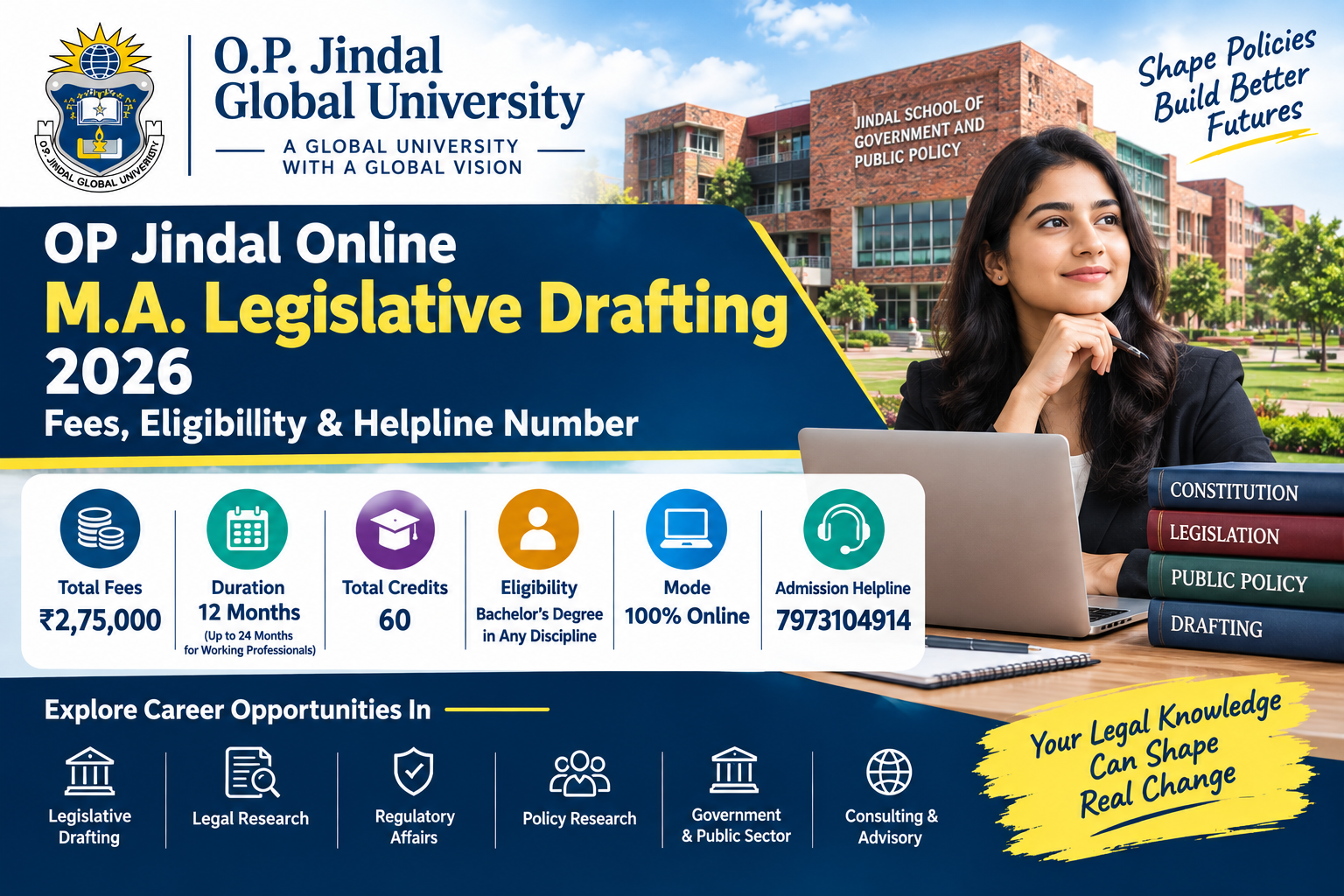
Legislative drafting is an important part of lawmaking, governance, and constitutional democracy. Every law, regulation, amendment, and statutory provision must be drafted carefully to communicate its meaning clearly, establish legal obligations, and support effective implementation. As governments and regulatory institutions deal with increasingly complex legal and policy challenges, the need for professionals with specialised legislative drafting knowledge continues to grow.
Admission Assistance Helpline: 7973104914
The OP Jindal Online M.A. Legislative Drafting 2026 programme is designed for graduates, legal professionals, government officials, policy researchers, and individuals interested in understanding how legislation is developed and drafted. The programme focuses on legislative processes, constitutional principles, statutory interpretation, legal language, policy analysis, and the practical preparation of legislative documents.
Offered by O.P. Jindal Global University through Jindal Global Law School, this specialised master’s programme provides an opportunity to study legislative drafting through an online learning format.
If you are searching for information about OP Jindal Online M.A. Legislative Drafting fees, eligibility criteria, duration, syllabus, admission process, and career opportunities, this detailed guide covers the major points you should understand before applying.
For admission guidance and application assistance, you can contact the admission assistance helpline at 7973104914.
OP Jindal Online M.A. Legislative Drafting 2026: Programme Highlights
The following table summarises the key programme details.
| Particulars | Details |
|---|---|
| Programme Name | M.A. Legislative Drafting |
| University | O.P. Jindal Global University |
| School | Jindal Global Law School |
| Academic Level | Postgraduate |
| Study Mode | Online |
| Duration | 12 months |
| Total Credits | 60 credits |
| Total Programme Fee | ₹2,75,000 |
| Eligibility | Bachelor’s degree with 50% marks from a recognised university |
| Alternative Eligibility Route | Applicants below 50% may be required to take JSAT |
| Selection Requirement | Statement of Purpose and CV, as applicable |
| Main Subjects | Legislative drafting, constitutional framework, statutory interpretation, legal language and policy analysis |
| Admission Assistance Helpline | 7973104914 |
Note: Programme requirements, selection conditions, fee schedules, and intake dates can change. Confirm the current details before applying.
What Is OP Jindal Online M.A. Legislative Drafting?
The M.A. Legislative Drafting is a specialised postgraduate programme that focuses on the principles and practice of preparing laws and regulations.
Legislative drafting involves converting policy decisions and legal objectives into clear, structured, and legally effective written provisions. A well-drafted law should communicate its purpose, define rights and responsibilities, establish procedures, and minimise ambiguity.
For example, when a government introduces a new policy, the policy may need to be translated into a Bill, an amendment, a regulation, or another legal instrument. The drafting process requires an understanding of constitutional authority, legal terminology, statutory interpretation, and the practical consequences of the proposed provisions.
The programme aims to help students understand these processes and develop specialised knowledge of how legislation is designed, written, reviewed, and structured.
Unlike a general law degree, this programme focuses specifically on legislative drafting and related areas. It brings together legal principles, governance, policy design, research, and plain-language drafting.
Why Choose OP Jindal Online M.A. Legislative Drafting in 2026?
Selecting a postgraduate programme requires careful consideration of its curriculum, academic requirements, flexibility, cost, and relevance to your professional goals.
1. Specialised Knowledge of Legislative Drafting
Legislative drafting is a specialised area that requires more than general knowledge of law. Drafting professionals need to understand how statutory provisions are structured, how legal terms are used, and how different sections of legislation work together.
This programme focuses on developing an understanding of legislative drafting theory and practice.
2. Study Constitutional and Legal Principles
Legislation must operate within the applicable constitutional and legal framework. Students explore how constitutional principles, legislative competence, statutory interpretation, and legal coherence influence the preparation of laws.
This knowledge is particularly relevant to people interested in lawmaking, regulatory work, legal research, and public institutions.
3. Learn About Plain-Language Drafting
Legal documents can become difficult to understand when they use unnecessarily complicated language or unclear sentence structures. Plain-language drafting aims to communicate legal meaning more effectively without sacrificing precision.
Students can explore how clarity, consistency, and careful word choice contribute to better legal documents.
4. Understand Policy and Lawmaking
Legislative drafting is closely connected to public policy. A policy proposal may need to be translated into enforceable legal provisions, and the drafting process must consider its purpose, implementation, and potential consequences.
The programme connects policy analysis with legislative development.
5. Online Learning Flexibility
The online format can be useful for graduates and working professionals who want to pursue postgraduate study without relocating to attend a conventional full-time campus programme.
However, students should still plan their study schedule carefully and meet the programme’s academic requirements.
6. Develop Practical Drafting Capabilities
The curriculum includes subjects related to primary legislation, subordinate legislation, statutory interpretation, legal language, and a capstone legislative drafting project.
These subjects can help learners understand how legislative documents are organised and how legal provisions can be reviewed for clarity and coherence.
OP Jindal Online M.A. Legislative Drafting Fees 2026
The listed total programme fee is ₹2,75,000.
According to the published fee schedule, the amount is divided into a registration payment and two instalments.
| Fee Component | Amount |
|---|---|
| Registration Fee | ₹25,000 |
| First Instalment | ₹1,25,000 |
| Second Instalment | ₹1,25,000 |
| Total Programme Fee | ₹2,75,000 |
How Is the Fee Paid?
The published payment structure provides for the following schedule:
- Registration fee: ₹25,000 upon acceptance of the offer letter.
- First instalment: ₹1,25,000 before the batch commences.
- Second instalment: ₹1,25,000 by 15 January 2027, according to the listed schedule.
The final payment dates should be checked against the admission offer for your specific intake.
Is the Registration Fee Included in the Total?
Yes. The ₹25,000 registration payment is included in the published total of ₹2,75,000. It is not an additional amount on top of that total.
Students should read the payment terms carefully and verify the applicable refund policy before making any payment.
Are EMI or Financing Options Available?
A financing or instalment facility may be available, subject to the university’s current arrangements and the applicant’s eligibility.
Before choosing a financing option, review the interest or service charges, repayment period, eligibility conditions, and total amount payable.
What Should Students Check Before Paying?
Before paying the fee, confirm:
- The total programme fee for your intake.
- The registration payment deadline.
- The dates for subsequent instalments.
- The refund and cancellation conditions.
- Any applicable financing charges.
- Whether any additional fees apply to your particular circumstances.
Always use the latest written fee schedule as the final reference for payment.
OP Jindal Online M.A. Legislative Drafting Eligibility Criteria 2026
Understanding the eligibility requirements is essential before beginning the application process.
Educational Qualification
Applicants generally need a bachelor’s degree with at least 50% marks from a recognised university.
The programme is designed for learners with different academic and professional backgrounds. Applicants should check the university’s current criteria to confirm that their undergraduate qualification is acceptable.
Can Students Without a Law Degree Apply?
A prior law degree is not listed as a mandatory requirement in the published programme information.
The programme is designed to be relevant to both legal and non-legal backgrounds, including people working in governance, public administration, regulatory affairs, research, and policy-related fields.
However, applicants should not assume that every professional background automatically satisfies the admission requirements. The university’s current eligibility and selection rules will determine admission.
What If You Have Less Than 50% Marks?
The published programme information indicates that candidates with less than 50% marks may be required to take the JSAT examination, along with submitting the other required application materials.
Applicants in this category should confirm the applicable test requirements and selection conditions with the admissions team before submitting their application.
Is Work Experience Mandatory?
The published programme information does not list work experience as a universal mandatory requirement. The programme may be relevant to recent graduates as well as working professionals.
Candidates should review the current admission criteria for any additional conditions applicable to their intake.
Documents Required for Admission
Prepare the following documents, as applicable:
- Bachelor’s degree certificate or provisional certificate.
- Undergraduate marksheets or academic transcripts.
- Valid government-issued identification.
- Updated curriculum vitae (CV).
- Statement of Purpose (SOP).
- Any additional documents requested during the application process.
Applicants should ensure that their personal details and academic records are accurate and consistent across all submitted documents.
OP Jindal Online M.A. Legislative Drafting Duration 2026
The listed duration of the programme is 12 months.
The programme is structured as an intensive one-year postgraduate course covering 60 credits across four quarters.
Students should plan for regular academic engagement throughout the programme. Online study does not mean that assignments, readings, assessments, or project work can be completed without a consistent time commitment.
Applicants who are employed full-time should consider their professional responsibilities before enrolling.
OP Jindal Online M.A. Legislative Drafting Syllabus 2026
The programme’s curriculum focuses on legislative theory, legal interpretation, constitutional principles, legal writing, and practical drafting.
The published structure includes four quarters, each carrying 15 credits.
Quarter 1: Foundations of Legislative Drafting
The first quarter introduces students to the foundations of lawmaking and legislative design.
1. Introduction to Legislative Drafting and the Legislative Process
This subject introduces the stages involved in developing legislation. Students explore how a policy objective can be translated into a legislative proposal and how the legislative process influences the structure and content of a legal instrument.
2. Constitutional Framework for Legislative Drafting
Legislation must comply with the applicable constitutional framework. This subject examines constitutional principles relevant to legislative authority, legal validity, and the design of statutory provisions.
3. Statutory Interpretation for Legislative Counsels and Drafters
Statutory interpretation involves understanding the meaning and application of legislative provisions. Students explore why precise language, consistent terminology, and logical structure are important in reducing ambiguity.
Quarter 2: Legal Language, Policy and Research
The second quarter focuses on the language and analytical skills needed for effective legislative drafting.
4. Legal Language and Plain Language Drafting
This subject examines how legal documents can communicate complex ideas accurately and clearly. Students explore the importance of sentence structure, defined terms, consistent wording, and accessible legal language.
5. Policy Analysis for Legislative Counsels and Drafters
Policy analysis helps drafters understand the objectives behind proposed legislation. It can involve examining the problem being addressed, comparing policy options, considering implementation challenges, and assessing the likely effects of proposed legal provisions.
6. Research Methods for Legislative Drafting
Research methods help learners identify relevant legal materials, review existing legislation, organise evidence, and develop well-supported drafting recommendations.
Quarter 3: Practical Legislative Drafting
The third quarter moves towards applying legislative drafting concepts to different types of laws.
7. Drafting of Primary Legislation and Subordinate Legislation
Primary legislation and subordinate legislation have different roles in the legal system. This subject explores the structure and drafting considerations involved in preparing Bills, Acts, regulations, and other legal instruments.
8. Legislative Drafting for Social, Economic and Commercial Laws
Laws dealing with social, economic, and commercial matters may involve different institutions, stakeholders, rights, duties, and regulatory requirements. Students explore drafting considerations relevant to these areas.
9. Financial and Tax Legislative Drafting
Financial and tax legislation often deals with technical concepts, payment obligations, compliance requirements, and administrative procedures. This subject examines the importance of precision and consistency when drafting such provisions.
Quarter 4: Comparative Practice, Ethics and Capstone
The final quarter focuses on comparative approaches, professional responsibility, and the application of learning.
10. Comparative Legislative Drafting
Comparative legislative drafting involves studying different approaches to preparing laws and regulations. This can help learners understand alternative drafting conventions and consider which practices may be suitable for particular legal contexts.
11. Ethics, Accountability, and Transparency in Legislative Drafting
Legislative drafting requires attention to accuracy, accountability, transparency, and the responsible use of legal authority. This subject examines ethical considerations that may arise during the preparation and review of legislation.
12. Capstone Legislative Drafting Project
The capstone project provides an opportunity to apply concepts from the programme to a legislative drafting task. It can help students bring together legal research, policy understanding, statutory structure, and drafting skills.
The subjects above reflect the published curriculum structure. Refer to the university’s current programme documentation for the final course requirements and assessment details.
What Skills Can You Develop Through the Programme?
The programme can help learners develop capabilities relevant to legislative, regulatory, legal research, and policy-related work.
1. Legislative Drafting
Understanding how to structure legal provisions, organise sections, define terms, and express legal obligations clearly.
2. Statutory Interpretation
Examining how legal provisions are read and understood, and how drafting choices may affect their interpretation.
3. Constitutional Awareness
Understanding why legislation must be developed within the applicable constitutional framework.
4. Legal Research
Finding and reviewing relevant legal materials, analysing existing laws, and supporting drafting decisions with appropriate research.
5. Plain-Language Communication
Improving the clarity and accessibility of legal documents while maintaining legal accuracy.
6. Policy Analysis
Understanding the objectives behind proposed laws and examining how legal provisions may help achieve policy goals.
7. Critical Thinking
Identifying possible ambiguity, inconsistent provisions, implementation difficulties, and other drafting issues.
8. Ethical and Professional Judgment
Recognising the importance of transparency, accountability, legal compliance, and responsible professional practice.
The level of expertise developed will depend on the learner’s participation, prior knowledge, academic performance, and continued practical experience.
OP Jindal Online M.A. Legislative Drafting Career Opportunities
Legislative drafting is relevant to several professional environments, including government, legal services, regulatory institutions, public policy, and research.
The programme may support learners who want to develop specialised knowledge for roles related to legislation and governance.
1. Legislative Drafting Professional
Legislative drafting professionals work on the preparation, review, and refinement of legislative documents. Their work may involve structuring provisions, defining legal terms, reviewing consistency, and ensuring that drafts reflect their intended purpose.
Appointments to formal legislative drafting positions may require specific recruitment qualifications, examinations, legal experience, or government service eligibility.
2. Legislative Researcher
Legislative researchers study proposed laws, amendments, legal developments, and policy issues. They may prepare research notes, legislative summaries, comparative analyses, or briefing documents.
3. Legal Research Associate
Legal research associates assist with analysing legislation, judgments, regulations, and legal materials. Research and writing skills are important in law firms, research organisations, legal departments, and academic environments.
4. Regulatory Affairs Professional
Regulatory affairs professionals help organisations understand legal and regulatory requirements, assess policy changes, and maintain compliance with applicable rules.
Relevant work experience and sector-specific knowledge may be important for these roles.
5. Government and Public Administration Professional
Government departments and public institutions may require professionals who understand legislation, administrative processes, legal compliance, and policy implementation.
Recruitment conditions differ across departments and positions.
6. Public Policy Researcher
Public policy researchers examine government programmes, regulatory proposals, and legislative developments. They may study how laws affect public services, economic activity, social development, or institutional processes.
7. Legislative and Policy Consultant
Consultants may assist with legislative research, policy reviews, regulatory analysis, or the assessment of proposed legal frameworks. Entry into these roles depends on experience, employer expectations, and relevant expertise.
8. Legal and Compliance Professional
The knowledge gained from studying legislation and statutory interpretation may complement work involving legal documentation, regulatory compliance, and internal policy review.
The exact responsibilities and eligibility requirements depend on the organisation and the role.
9. Think Tank and Research Organisation Professional
Think tanks and research institutions may conduct studies on lawmaking, governance, public institutions, regulatory reform, and public policy. Strong research and communication skills can be useful in these environments.
10. Academic and Further Research Pathways
Learners who develop an interest in legal research may consider further academic study or research-oriented opportunities, subject to the entry requirements of the relevant institution.
Important career note: Completing the degree does not guarantee a job, a government appointment, a particular salary, or eligibility for every legislative drafting position. Formal positions may require additional qualifications, recruitment examinations, professional experience, or other conditions.
Who Should Consider OP Jindal Online M.A. Legislative Drafting?
The programme may be suitable for several types of learners.
Law graduates: Students who want to build specialised knowledge of drafting laws, interpreting statutes, and analysing legislative structures.
Government employees: Officials who work with legislation, regulations, administrative rules, or policy documents may find the subject relevant to their professional development.
Legal professionals: Lawyers and legal researchers interested in statutory interpretation, legal writing, or legislative research may consider the programme.
Public policy professionals: People involved in policy analysis may benefit from understanding how policy proposals can be translated into legislative provisions.
Regulatory professionals: Individuals working with regulatory frameworks may want to develop a stronger understanding of legislative structure and legal language.
Recent graduates: Eligible graduates interested in lawmaking, governance, legal research, and legislative processes may explore the programme even if they have limited professional experience.
Before applying, candidates should assess the curriculum and confirm that it matches their academic and career objectives.
OP Jindal Online M.A. Legislative Drafting Admission Process 2026
The admission process may involve the following steps. Applicants should follow the latest instructions provided for their chosen intake.
Step 1: Check the Eligibility Criteria
Review the educational requirements and confirm whether your bachelor’s degree and academic marks meet the current admission criteria.
Step 2: Prepare Your Application Documents
Collect your academic records, identification, CV, and other required documents before beginning the application.
Step 3: Complete the Application Form
Enter your personal, academic, and professional information accurately. Check your details before submitting the form.
Step 4: Write Your Statement of Purpose
The published selection requirements include a Statement of Purpose of approximately 700–750 words.
Your SOP should explain why you are interested in legislative drafting, how the programme fits your background, and what you hope to achieve academically or professionally.
A strong SOP should be clear, relevant, and based on your genuine interests. Avoid unsupported claims or generic statements that do not explain why you are applying.
Step 5: Submit Your CV
Prepare a clear CV that presents your education, work experience, research activities, internships, relevant skills, and other relevant achievements.
Recent graduates can highlight academic projects, internships, research assignments, and extracurricular activities that demonstrate their interest in law, governance, or policy.
Step 6: Complete Any Additional Assessment
Applicants with less than 50% marks may be required to take JSAT, according to the published programme information. Confirm whether this requirement applies to your circumstances and follow the current instructions.
Step 7: Review the Admission Decision
If you receive an offer, carefully check the conditions, fee schedule, payment deadlines, and enrolment instructions before accepting.
Step 8: Complete Fee Payment and Enrolment
Pay the required amount through the authorised payment process and complete any remaining enrolment formalities.
Is Admission Open for OP Jindal Online M.A. Legislative Drafting 2026?
The programme’s published information lists a batch start date of 1 September 2026. As the current date is October 2026, that listed start date has already passed.
Applicants interested in joining now should contact the university or its admissions team to confirm whether a later intake is available, whether applications are still being accepted, and what the next application deadline will be.
Do not assume that the September intake is still open simply because older promotional material mentions admissions for 2026.
For admission guidance, application assistance, and help understanding the requirements, contact 7973104914.
Is OP Jindal Online M.A. Legislative Drafting Suitable for Working Professionals?
The online format may be convenient for people who want to pursue postgraduate study while continuing their existing professional responsibilities.
For example, a legal researcher may want to improve their understanding of statutory interpretation, while a government employee may be interested in legislative structure and policy implementation.
However, the programme is listed as an intensive one-year course. Students should consider their work schedule, family responsibilities, academic workload, and assignment deadlines before enrolling.
It is helpful to prepare a realistic study plan that allocates time for reading, research, writing, and assessments.
OP Jindal Online M.A. Legislative Drafting vs. General LL.M.
Students interested in specialised legal study may compare legislative drafting with a general Master of Laws (LL.M.) programme.
| Feature | M.A. Legislative Drafting | General LL.M. |
|---|---|---|
| Main Focus | Preparing and analysing laws and regulations | Advanced study of law, often through a chosen legal specialisation |
| Key Subjects | Legislative process, statutory interpretation, legal language, drafting | Depends on the chosen LL.M. specialisation |
| Main Learning Goal | Develop specialised knowledge of legislative drafting | Develop advanced knowledge of a legal field |
| Intended Interests | Lawmaking, regulatory work, legislative research, policy-related work | Advanced legal practice, research, or specialised legal study |
| Eligibility | Follow the programme’s published bachelor’s degree criteria | Depends on the specific LL.M. programme |
These programmes serve different academic purposes. Applicants should compare their eligibility criteria and curriculum before deciding which qualification better matches their goals.
Benefits of Learning Legislative Drafting in 2026
Legislative drafting connects legal principles with the practical operation of public institutions. Understanding this field can help learners examine several important issues.
- Clearer laws: Understanding the importance of precise wording and consistent terminology.
- Better statutory structure: Learning how provisions, definitions, exceptions, and procedures fit together.
- Constitutional awareness: Recognising the need to consider constitutional principles when legislation is developed.
- Improved policy implementation: Understanding how legislative provisions translate policy objectives into legal rules.
- Regulatory understanding: Examining how laws and regulations establish responsibilities and compliance requirements.
- Legal research: Developing the ability to investigate legislative issues and analyse existing legal frameworks.
- Accessible legal language: Exploring how legislation can communicate legal requirements clearly to its intended readers.
These skills can be valuable in legal and policy environments, but professional competence also requires practical experience and continued learning.
OP Jindal Online M.A. Legislative Drafting Admission Assistance Helpline
Students often need guidance about the programme fee, eligibility requirements, SOP preparation, documentation, selection process, and intake schedule before applying.
For admission assistance and guidance with understanding the application process, contact:
Admission Assistance Helpline: 7973104914
Before submitting an application or making a payment, confirm the latest requirements and intake availability. Use the university’s current written information to verify all programme details.
Frequently Asked Questions (FAQs)
1. What is the total fee for OP Jindal Online M.A. Legislative Drafting 2026?
The published total programme fee is ₹2,75,000. It includes a ₹25,000 registration fee and two instalments of ₹1,25,000 each.
2. What is the duration of the programme?
The listed duration is 12 months, with a total of 60 credits.
3. What is the eligibility for OP Jindal Online M.A. Legislative Drafting?
The published criteria generally require a bachelor’s degree with at least 50% marks from a recognised university. Applicants should confirm the current requirements before applying.
4. Can a student without a law degree apply?
The published programme information does not make a prior law degree mandatory. Eligible applicants from other academic backgrounds may consider applying, subject to the university’s admission criteria.
5. What happens if I have less than 50% marks?
The published programme information indicates that candidates with less than 50% marks may be required to take JSAT and submit the other required application materials. Confirm the current process with the admissions team.
6. Is work experience compulsory?
Work experience is not listed as a universal mandatory requirement in the published programme information. Applicants should check the current admission conditions for their intake.
7. What is the syllabus of the programme?
The curriculum includes legislative drafting and the legislative process, constitutional principles, statutory interpretation, plain-language drafting, policy analysis, research methods, primary and subordinate legislation, financial and tax drafting, comparative drafting, ethics, and a capstone project.
8. Is the programme available online?
Yes. The programme is listed as an online master’s degree with a duration of 12 months.
9. What is the Statement of Purpose requirement?
The published selection information specifies an SOP of approximately 700–750 words. Applicants should explain their interest in legislative drafting and how the programme relates to their objectives.
10. What career opportunities may be available after the programme?
Possible career directions include legislative research, legal research, regulatory affairs, policy research, legislative drafting, and related consulting work. Specific job eligibility depends on the employer, experience, and other professional requirements.
11. Is admission still open for the September 2026 batch?
The listed start date of 1 September 2026 has passed. Contact the university to check whether a later intake or another application route is available.
12. What is the admission assistance helpline number?
For admission guidance, contact 7973104914.
Conclusion
The OP Jindal Online M.A. Legislative Drafting 2026 programme is a specialised postgraduate option for graduates and professionals interested in the preparation, interpretation, and analysis of legislation. With a listed duration of 12 months, 60 credits, and a total programme fee of ₹2,75,000, the course focuses on legislative processes, constitutional principles, statutory interpretation, legal language, policy analysis, and practical drafting.
The programme may be relevant to learners interested in legal research, legislative affairs, governance, regulatory work, and public policy. However, applicants should carefully review the curriculum, confirm their eligibility, prepare the required SOP and CV, and verify the next available intake before applying.








 Collegekampus.com