

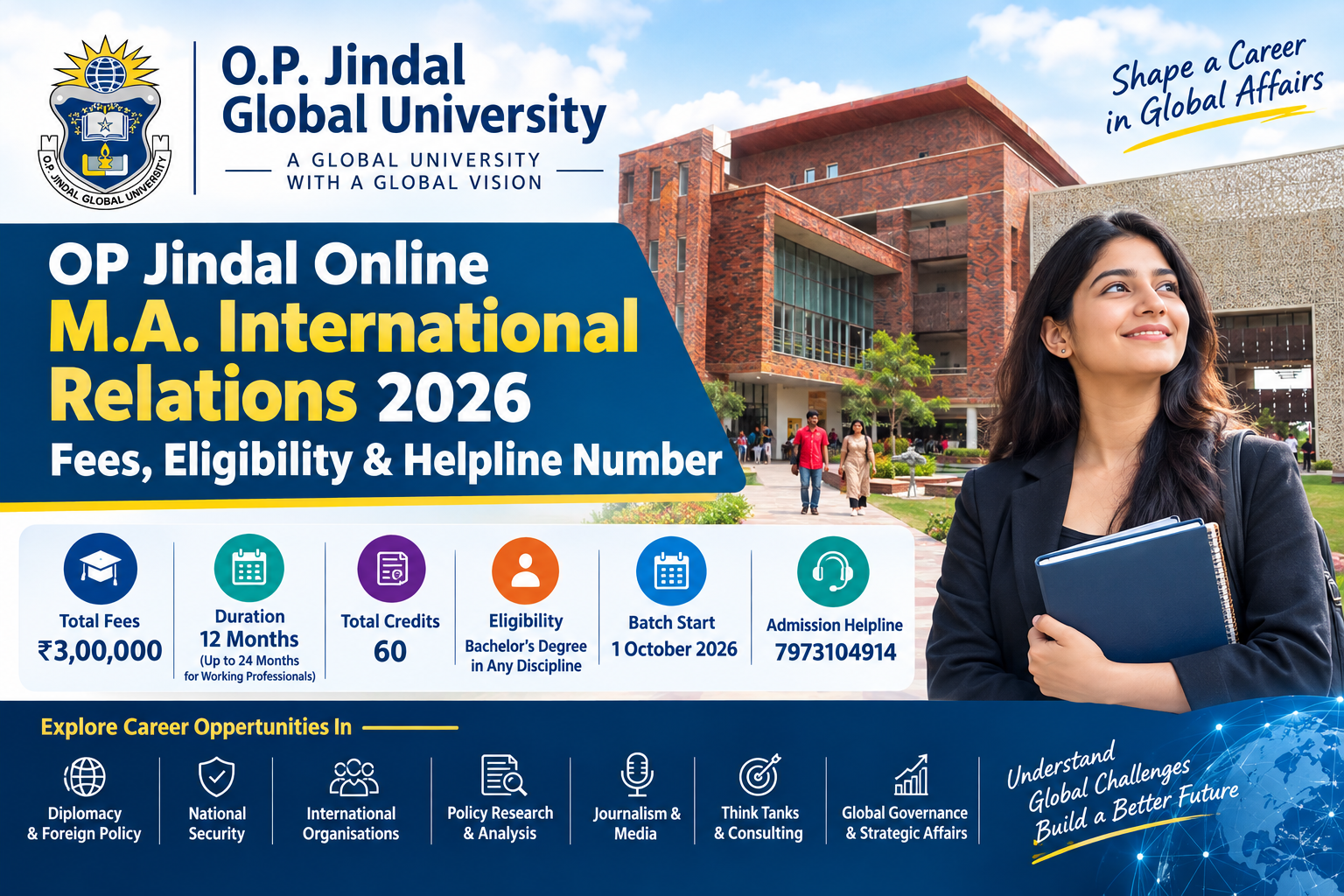
The OP Jindal Online M.A. International Relations 2026 is a specialised postgraduate programme for students and working professionals interested in international affairs, diplomacy, geopolitics, national security, foreign policy, strategic studies, global governance, and conflict resolution.
The official programme is titled M.A. in International Relations, Security & Strategy (MA-IRSS) and is offered by the Jindal School of International Affairs (JSIA), O.P. Jindal Global University. The current 2026 programme information lists a total tuition fee of ₹3,00,000, 60 credits, and a standard completion period of 12 months. Students who need additional flexibility can extend their studies for up to two additional years.
The programme is delivered 100% online and is designed to provide students with an understanding of international relations, diplomacy, security, strategic affairs, foreign policy, intelligence, conflict resolution, and global politics.
If you are searching for OP Jindal Online M.A. International Relations fees, eligibility, syllabus, duration, admission process, career scope, or helpline number, this detailed guide covers the major aspects of the programme.
OP Jindal Online M.A. International Relations 2026 – Highlights
| Particular | Details |
|---|---|
| Programme | M.A. in International Relations, Security & Strategy |
| University | O.P. Jindal Global University |
| School | Jindal School of International Affairs |
| Mode | 100% Online |
| Duration | 12 Months |
| Flexible Completion | Up to 24 Months |
| Batch Start | 1 October 2026 |
| Total Credits | 60 |
| Total Tuition Fee | ₹3,00,000 |
| Eligibility | Bachelor’s Degree in Any Discipline |
| Background Required | No prior International Relations background required |
| Study Commitment | Around 12–15 hours per week |
| Intakes | April and October |
| Admission Helpline | 7973104914 |
The programme consists of 12 courses spread across four terms. Students complete core courses in international relations, diplomacy, intelligence, security, foreign policy, terrorism, maritime security, law, ethics, and conflict resolution before choosing a dissertation or elective pathway.
What is OP Jindal Online M.A. International Relations?
The OP Jindal Online M.A. in International Relations, Security & Strategy is a postgraduate degree designed to develop a deeper understanding of the forces shaping international politics and global security.
International relations is no longer limited to traditional diplomacy between countries. Modern international affairs involve:
- Geopolitical competition
- Foreign policy
- National security
- Cybersecurity
- Maritime security
- Terrorism and counterterrorism
- International organisations
- Global economic relationships
- Climate and migration
- Strategic affairs
- Military conflict
- Intelligence
- Peace and conflict resolution
The programme combines these areas into an interdisciplinary curriculum.
It is offered by the Jindal School of International Affairs, allowing learners to study international relations, diplomacy and security strategy through an online format.
Why Choose OP Jindal Online M.A. International Relations 2026?
There are several reasons why students and professionals may consider this programme.
1. Specialised International Relations Degree
Instead of studying a general management or humanities programme, students can specialise in international relations, security and strategy.
The curriculum focuses directly on global politics, diplomacy, foreign policy, intelligence, security and strategic affairs.
2. 100% Online Learning
The programme is delivered online, allowing students to study without relocating to a university campus.
The current programme structure combines pre-recorded learning, readings, live sessions, discussions and assessments.
3. Flexible Completion
The standard structure allows the programme to be completed in 12 months.
However, working professionals who require additional time can extend their studies by up to two additional years.
4. Global Perspective
International relations requires understanding events from multiple perspectives.
The programme is designed for a global audience and provides exposure to international politics, geopolitical issues, diplomacy, security and foreign policy.
5. Learn From Experts and Practitioners
The programme highlights learning from experts and practitioners associated with international affairs, including diplomats, policymakers and national-security professionals.
OP Jindal Online M.A. International Relations Fees 2026
The OP Jindal Online M.A. International Relations fees for 2026 are ₹3,00,000 for Indian applicants.
The current tuition information lists the following payment structure:
| Fee Component | Amount |
|---|---|
| Registration Fee | ₹50,000 |
| Instalment 1 | ₹1,25,000 |
| Instalment 2 | ₹1,25,000 |
| Total Tuition Fee | ₹3,00,000 |
The ₹50,000 registration payment is adjusted against the overall programme tuition. The remaining amount can be paid through the listed instalment structure.
Is the OP Jindal Online M.A. International Relations Fee Affordable?
For students looking for a specialised master’s degree in international relations, the online format can provide an alternative to relocating for a conventional full-time programme.
The programme also allows eligible learners to study from different locations because the degree is delivered online.
OP Jindal Online M.A. International Relations Eligibility 2026
One of the important advantages of this programme is its broad academic eligibility.
Candidates need:
Bachelor’s Degree
Applicants should have an undergraduate degree in any discipline from a recognised university in India or abroad.
A previous degree specifically in international relations, political science or social sciences is not mandatory.
This means graduates from different educational backgrounds can consider the programme.
For example, applicants may come from:
- Political Science
- History
- Economics
- Law
- Sociology
- Journalism
- Mass Communication
- Commerce
- Management
- Engineering
- Technology
- Humanities
- Social Sciences
The programme does not require prior professional experience either, making it accessible to recent graduates as well as working professionals.
Who Can Apply for OP Jindal Online M.A. International Relations?
The programme can be suitable for a wide range of candidates.
Recent Graduates
Graduates who want to specialise in global affairs can use the programme as a postgraduate pathway.
Working Professionals
Professionals working in government, consulting, journalism, research, NGOs, corporate affairs or related areas can pursue the degree alongside their careers.
Civil Services Aspirants
Students preparing for careers related to foreign policy, international affairs and public administration may find the academic content relevant to their broader interests.
Journalists
Journalists interested in international affairs, geopolitical reporting and global politics can develop specialised knowledge.
Policy Professionals
People working in policy research and public affairs can strengthen their understanding of international institutions and strategic affairs.
Defence and Security Aspirants
Students interested in strategic studies, national security, intelligence and defence-related subjects can explore the programme.
OP Jindal Online M.A. International Relations Duration
The programme has a standard duration of 12 months.
The curriculum is divided into four terms and requires completion of 60 credits.
Students generally study around 12–15 hours per week.
For working professionals who cannot complete the programme within the standard timeline, the university’s current programme information allows an extension of up to two additional years.
This makes the programme particularly relevant for people balancing education with employment or other responsibilities.
OP Jindal Online M.A. International Relations Syllabus 2026
The syllabus is one of the most important parts of the programme.
The curriculum consists of core international relations and security courses followed by a final-term dissertation or elective pathway.
Term 1 – Foundations of International Relations
The first term builds the foundation required to understand global politics.
International Relations Theory
Students study major theories and approaches used to understand international politics.
The course connects theoretical concepts with real-world international events, cooperation, conflicts and strategic decision-making.
Diplomatic Practices
This subject introduces the practical dimensions of diplomacy.
Students explore areas such as:
- Embassies
- Negotiations
- Public diplomacy
- Diplomatic communication
- International representation
- Digital diplomacy
Intelligence, War and Weapons
This course explores intelligence, warfare, military strategy and changing technologies of conflict.
Students gain an understanding of how intelligence and military capabilities influence international security.
Term 2 – Foreign Policy, Terrorism & Maritime Security
The second term moves deeper into international security.
Foreign Policies of Great, Middle and Small Powers
Students examine how countries with different levels of economic, political and military power develop foreign policies.
The course helps students understand strategic choices made by major global powers.
Terrorism, Counterterrorism and Unconventional Threats
This course explores terrorism, extremist networks and the challenges involved in developing counterterrorism strategies.
Students examine the political and security dimensions of unconventional threats.
Maritime Security and Naval Strategy
Maritime security has become increasingly important because of global trade, strategic waterways and Indo-Pacific geopolitics.
The course covers:
- Maritime threats
- Naval strategy
- Maritime law
- Indo-Pacific security
- Naval power
- Strategic competition
The core curriculum is designed to connect these concepts with contemporary global security challenges.
Term 3 – Intelligence, Law & Conflict Resolution
The third term focuses on analytical and practical international affairs skills.
Intelligence Analysis and Risk Assessment
Students learn how intelligence can be interpreted and used for strategic decision-making.
Topics include:
- Intelligence analysis
- Risk assessment
- Strategic decision-making
- Analytical frameworks
- Real-world case studies
Law and Ethics in International Relations
International politics frequently involves difficult legal and ethical questions.
This course examines issues such as:
- Humanitarian intervention
- Use of force
- Terrorism
- Climate responsibility
- International law
- Ethical decision-making
Negotiating and Resolving International Conflicts
Students learn about negotiation, peacebuilding and conflict transformation.
The subject can be particularly relevant to careers involving diplomacy, mediation, international organisations and conflict resolution.
Term 4 – Dissertation or Elective Pathway
The final term gives students flexibility.
Students can choose between a dissertation pathway and a non-dissertation pathway.
Dissertation Pathway
Students completing the dissertation pathway undertake:
- Dissertation – 12 credits
- Research Methodology, Ethics and Academic Writing – 3 credits
The dissertation is developed under the guidance of an assigned faculty mentor.
This option can be particularly useful for students interested in:
- Research
- Academia
- Policy analysis
- Think tanks
- Further postgraduate study
- International affairs research
Non-Dissertation Elective Pathway
Students who do not select the dissertation route can choose three courses worth 15 credits.
Available elective areas include:
- Domestic Politics and Foreign Policy
- Nuclear, Space and Cyber Security
- Climate Change, Migration and Human Security
- Military Conflict and Deterrence
- China-US New Cold War and Indo-Pacific
- Multilateral Institutions and Global Security
- India’s Rise in World Affairs
Students can also select a cross-elective from areas such as:
- International Organisations and Policy Regimes
- Qualitative Analysis and Survey Design
- Statistical Methods and Data Analysis
- Development Economics
- Democratic Governance
Skills You Can Develop Through the Programme
The programme can help students develop a combination of analytical, research and strategic skills.
International Relations Analysis
Understanding how countries interact and how global systems influence international politics.
Foreign Policy Analysis
Evaluating why governments adopt particular foreign-policy strategies.
Diplomatic Skills
Understanding diplomatic practices, negotiation and international representation.
Intelligence Analysis
Learning how information and intelligence can be analysed for strategic decisions.
Strategic Thinking
Understanding security challenges and long-term geopolitical consequences.
Conflict Resolution
Developing knowledge of negotiation, peacebuilding and conflict transformation.
Research Skills
Students choosing the dissertation pathway can develop advanced research and academic writing capabilities.
Global Political Awareness
Students gain a broader understanding of global political developments and geopolitical relationships.
Online Learning Format
The programme is designed around an online learning environment.
The current curriculum information includes:
- Pre-recorded video lectures
- Essential readings
- Live interactive sessions
- Discussions
- Graded assessments
- Practice questions
- Faculty assessments
- Peer learning
The programme indicates approximately 75 hours of learning engagement per course, including videos, readings, live sessions, assessments and discussions.
This structure allows students to combine independent learning with interactive academic engagement.
Assessment Pattern
Students are assessed through both formative and summative methods.
The programme includes:
Weekly Assessments
Learners complete auto-graded assessments aligned with course learning objectives.
Practice Questions
Practice questions provide opportunities to review concepts and prepare for graded assessments.
Faculty-Graded Assessments
Faculty evaluate selected assessments at the end of courses.
Discussion Activities
Discussion prompts encourage students to engage with classmates and explore different perspectives.
Dissertation
Students selecting the dissertation pathway complete a research project during the final term.
Career Opportunities After OP Jindal Online M.A. International Relations
An M.A. in International Relations can support careers across government, international organisations, research, journalism, consulting, public affairs and civil society.
Potential career areas include:
- International Relations Analyst
- Policy Analyst
- Foreign Affairs Researcher
- Geopolitical Analyst
- International Affairs Consultant
- Diplomatic Affairs Professional
- Research Associate
- Political Risk Analyst
- Security Analyst
- Intelligence Researcher
- International Development Professional
- Public Affairs Professional
- International Journalist
- NGO/INGO Professional
- Think Tank Researcher
Career opportunities depend on the student’s skills, previous experience, networking, internships and professional goals.
Career Scope After M.A. International Relations
1. Diplomacy
Students interested in diplomacy can build knowledge around foreign policy, negotiation and international relations.
2. Government and Public Policy
International relations graduates can explore policy research and government-related opportunities.
3. Think Tanks
Think tanks require researchers and analysts who can study geopolitical, economic and security developments.
4. International Organisations
Students can explore opportunities with international organisations and development institutions depending on their qualifications and experience.
5. Journalism
International affairs knowledge can be valuable for journalists covering:
- Global politics
- International conflicts
- Diplomacy
- Foreign policy
- Geopolitics
6. Corporate Affairs
Multinational companies often monitor political, regulatory and geopolitical developments across countries.
7. Political Risk
Businesses operating internationally need to understand geopolitical and political risks.
8. Research
Students interested in academia and policy research can use the programme to strengthen their research background.
Is OP Jindal Online M.A. International Relations Good for Working Professionals?
The programme can be particularly suitable for working professionals because it is delivered completely online and allows flexibility in completion.
The standard programme is structured over 12 months, while professionals who require additional time can extend the programme.
A professional working in journalism, consulting, government affairs, corporate communications, research or policy can therefore continue working while studying.
The estimated study commitment is approximately 12–15 hours per week.
OP Jindal Online M.A. International Relations Admission Process 2026
The admission process can be approached through the following steps.
Step 1: Check Eligibility
Confirm that you have completed a bachelor’s degree from a recognised university.
Step 2: Start the Application
Submit the required application information for the online M.A. programme.
Step 3: Provide Academic Information
Applicants need to submit their undergraduate academic history.
Step 4: Submit Identification Documents
Applicants need to provide valid government-issued identification.
For Indian learners, acceptable identification options listed by the programme include documents such as Aadhaar, passport, PAN card or voter ID.
Step 5: Application Review
The application is reviewed according to the programme’s admission process.
Step 6: Admission Offer
Selected applicants receive an admission offer and can proceed with the registration payment.
Step 7: Begin the Programme
After completing the admission formalities and fee payment, students can begin their online learning journey.
Documents Required for Admission
Students should keep the following documents ready:
- Bachelor’s degree
- Undergraduate marksheets/transcripts
- Government-issued ID
- Passport-size photograph, if requested
- Other academic documents required during application
The current programme admission information specifically lists academic history and valid ID among the required documents.
Does M.A. International Relations Require a Political Science Background?
No.
A major advantage of the programme is that applicants do not need a previous degree in International Relations, Political Science or Social Sciences.
Candidates with a bachelor’s degree in any discipline can apply.
This makes the programme accessible to graduates from diverse educational backgrounds who want to transition into international affairs, diplomacy, policy, research or related careers.
Does M.A. International Relations Require Work Experience?
No mandatory work experience requirement is listed for admission.
The programme is suitable for both recent graduates and working professionals.
Professionals can use the degree to deepen their knowledge or transition toward international affairs, policy, security, diplomacy, research and geopolitical analysis.
Why International Relations is Important in 2026
International relations has become increasingly important because countries, businesses and organisations operate in a highly interconnected world.
Major developments in areas such as:
- Geopolitical competition
- Global security
- International trade
- Climate change
- Migration
- Cybersecurity
- Artificial intelligence
- Defence technology
- Energy security
- Maritime security
- International conflicts
can affect governments, businesses and societies around the world.
Professionals who understand these developments can contribute to better policy analysis, strategic planning, research and decision-making.
OP Jindal Online M.A. International Relations and Geopolitics
Geopolitics is an important part of understanding modern international relations.
The programme exposes students to topics involving:
- Great-power competition
- Foreign policy
- Indo-Pacific affairs
- China-US relations
- National security
- Maritime security
- International organisations
- Military strategy
- Global conflicts
Students can also choose electives such as The China-US New Cold War and the Indo-Pacific, India’s Rise in World Affairs, and Multilateral Institutions and Global Security.
OP Jindal Online M.A. International Relations and Diplomacy
Diplomacy is another major component of the programme.
The Diplomatic Practices course introduces students to:
- Diplomatic negotiations
- Embassies
- Public diplomacy
- International representation
- Digital diplomacy
- Strategic communication
These areas can be useful for students interested in international organisations, foreign affairs, government, journalism and policy research.
OP Jindal Online M.A. International Relations Admission Helpline Number
Students looking for admission assistance regarding the programme, eligibility, fees, application process and other admission-related queries can contact the admission assistance helpline:
7973104914
For students who are unsure whether their academic background is suitable for the programme, admission assistance can also help them understand the application process.
Frequently Asked Questions
1. What is OP Jindal Online M.A. International Relations?
It is an online postgraduate programme officially titled M.A. in International Relations, Security & Strategy, offered by the Jindal School of International Affairs at O.P. Jindal Global University.
2. What is the fee for OP Jindal Online M.A. International Relations 2026?
The current total tuition fee is ₹3,00,000 for Indian applicants.
3. What is the eligibility for M.A. International Relations?
Applicants need a bachelor’s degree in any discipline from a recognised university in India or abroad.
4. Is a Political Science degree required?
No. Candidates from any bachelor’s discipline can apply, and a previous background in International Relations or Social Sciences is not mandatory.
5. What is the duration of the programme?
The standard completion period is 12 months. Working professionals can extend their studies for up to two additional years if needed.
6. How many credits are required?
The programme requires 60 credits.
7. Is the programme completely online?
Yes. The programme is offered 100% online.
8. How many hours per week should students study?
The estimated student commitment is approximately 12–15 hours per week.
9. Does the programme include a dissertation?
Yes. Students can choose a dissertation pathway in the final term. The dissertation carries 12 credits along with a 3-credit Research Methodology, Ethics and Academic Writing course.
10. What careers can I pursue after M.A. International Relations?
Possible career areas include international affairs, policy research, diplomacy, geopolitical analysis, security analysis, journalism, international organisations, think tanks, consulting and corporate affairs.
11. Is this programme suitable for working professionals?
Yes. Its online format, estimated weekly workload and flexible completion option make it suitable for working professionals.
12. What is the OP Jindal Online M.A. International Relations admission helpline?
The admission assistance helpline for this campaign is 7973104914.
Final Conclusion
The OP Jindal Online M.A. International Relations 2026 is a specialised postgraduate programme for students and professionals who want to develop expertise in international relations, diplomacy, geopolitics, security, foreign policy, intelligence and strategic affairs.
The current programme offers a ₹3,00,000 total tuition fee, 60 credits and a standard 12-month completion structure, while allowing students who need additional flexibility to extend their studies. It is delivered completely online and accepts applicants with a bachelor’s degree in any discipline.
Its curriculum covers important areas including International Relations Theory, Diplomatic Practices, Intelligence, War and Weapons, Foreign Policy, Terrorism and Counterterrorism, Maritime Security, Intelligence Analysis, International Law and Ethics, Conflict Resolution, Cyber and Nuclear Security, Indo-Pacific affairs and India’s role in world affairs.
For students interested in diplomacy, international organisations, policy research, journalism, geopolitical analysis, security studies, consulting or international affairs, this programme can provide a focused academic foundation.







 Collegekampus.com