

📞 Admission Helpline: *9915567011*

Management education has evolved significantly over the past decade. Today, students and working professionals can pursue an MBA without attending regular classroom programs. Among the most popular flexible learning options are the Distance MBA and Online MBA.
While both programs allow learners to study remotely, they differ in teaching methods, learning experience, industry exposure, placement support, and career outcomes. Many students planning MBA admission in 2026 often struggle to decide which option is better for their career goals.
This comprehensive guide explains the key differences between Distance MBA and Online MBA, their benefits, eligibility criteria, career scope, salary potential, and how to choose the right program in 2026.
What is a Distance MBA?
A Distance MBA is a postgraduate management program where students receive study materials and learn independently without attending regular classes.
Traditionally, distance education focuses on self-paced learning. Universities provide printed or digital study materials, assignments, and examinations. Students generally do not participate in regular live lectures.
Features of Distance MBA
- Self-study learning model
- Printed and digital study materials
- Flexible schedule
- Limited interaction with faculty
- Affordable fee structure
- Suitable for working professionals
What is an Online MBA?
An Online MBA is a modern management degree delivered through digital platforms. Students attend live classes, access recorded lectures, interact with faculty, participate in discussions, complete projects, and appear for online assessments.
Online MBA programs are designed to provide an experience similar to regular MBA programs while offering flexibility.
Features of Online MBA
- Live interactive classes
- Recorded video lectures
- Learning Management System (LMS)
- Faculty interaction
- Placement assistance
- Industry-oriented curriculum
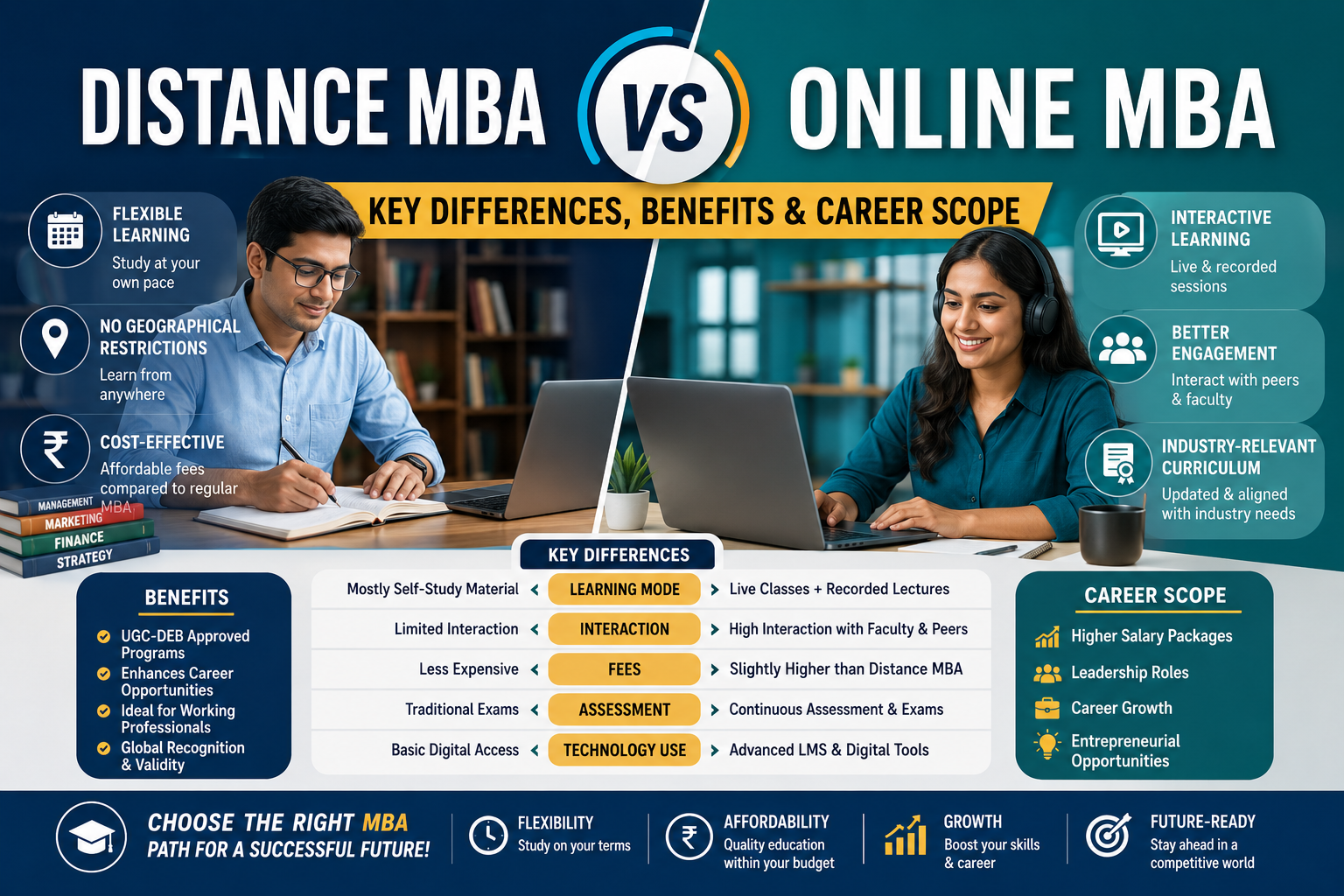
Distance MBA vs Online MBA: Quick Comparison
| Feature | Distance MBA | Online MBA |
|---|---|---|
| Learning Mode | Self-study | Live & recorded online classes |
| Faculty Interaction | Limited | High |
| Classroom Experience | No | Virtual classroom |
| Flexibility | High | High |
| Placement Support | Limited | Better |
| Networking Opportunities | Low | High |
| Technology Usage | Basic | Advanced |
| Industry Exposure | Moderate | Strong |
| Skill Development | Limited | Extensive |
| Employer Preference | Good | Increasingly Preferred |
Key Differences Between Distance MBA and Online MBA
1. Learning Experience
Distance MBA
Students study independently using learning materials provided by the university.
Online MBA
Students participate in virtual classrooms, webinars, group discussions, and live faculty sessions.
Winner
Online MBA offers a more engaging learning experience.
2. Faculty Interaction
Distance MBA
Communication with professors is generally limited.
Online MBA
Students regularly interact with faculty through live sessions, chat forums, and discussion boards.
Winner
Online MBA provides better academic support.
3. Technology and Learning Tools
Distance MBA
Uses basic learning resources such as study materials and assignments.
Online MBA
Includes:
- Live lectures
- Recorded videos
- AI-based learning tools
- Digital libraries
- Online assessments
Winner
Online MBA offers a more advanced learning environment.
4. Placement Assistance
Distance MBA
Placement support may be limited depending on the institution.
Online MBA
Many universities provide:
- Career counseling
- Resume building
- Interview preparation
- Placement drives
Winner
Online MBA generally offers stronger placement support.
5. Networking Opportunities
Distance MBA
Students have limited opportunities to connect with peers.
Online MBA
Students regularly collaborate through:
- Virtual classrooms
- Group projects
- Industry webinars
- Alumni networks
Winner
Online MBA provides better networking opportunities.
6. Cost of Education
Distance MBA
Usually more affordable.
Average Fees:
₹30,000 – ₹1 Lakh
Online MBA
Slightly higher due to advanced learning platforms.
Average Fees:
₹80,000 – ₹2.5 Lakh
Winner
Distance MBA is more budget-friendly.
Benefits of Distance MBA
Affordable Education
One of the biggest advantages is lower tuition fees.
Flexible Schedule
Students can learn at their own pace.
Suitable for Working Professionals
Ideal for individuals who cannot attend classes regularly.
Wide Accessibility
Available to students across India and abroad.
Self-Paced Learning
Allows students to balance education with personal and professional responsibilities.
Benefits of Online MBA
Interactive Learning Environment
Students actively participate in discussions and live sessions.
Better Industry Exposure
Many programs include industry projects and case studies.
Placement Support
Dedicated career services improve employment opportunities.
Modern Curriculum
Programs are regularly updated according to industry trends.
Enhanced Skill Development
Students develop:
- Leadership skills
- Communication skills
- Strategic thinking
- Digital business knowledge
Eligibility Criteria for Distance MBA and Online MBA
Most universities require:
Educational Qualification
Bachelor’s degree from a recognized university.
Minimum Marks
Generally 50% marks in graduation.
Entrance Exams
Many universities offer direct admission without CAT, MAT, XAT, or CMAT.
Top Universities Offering Distance MBA in India
IGNOU
One of India’s most trusted distance learning institutions.
Symbiosis Centre for Distance Learning (SCDL)
Offers industry-oriented management programs.
Annamalai University
Known for affordable distance education.
Karnataka State Open University (KSOU)
Popular among working professionals.
Top Universities Offering Online MBA in India
Amity University Online
Offers multiple specializations and placement support.
Manipal University Jaipur Online
Known for industry-relevant curriculum.
Lovely Professional University Online
Provides strong digital learning infrastructure.
Jain University Online
Offers modern MBA specializations.
Shoolini University Online
Focuses on career-oriented management education.
Career Scope After Distance MBA
Graduates can pursue roles such as:
- Marketing Executive
- HR Executive
- Operations Executive
- Sales Manager
- Business Development Executive
Average Salary
₹4 LPA – ₹8 LPA
Salary depends on skills, experience, and specialization.
Career Scope After Online MBA
Online MBA graduates are eligible for positions such as:
- Marketing Manager
- Financial Analyst
- HR Manager
- Business Analyst
- Operations Manager
- Project Manager
- Product Manager
Average Salary
₹5 LPA – ₹15 LPA+
Experienced professionals may earn significantly higher salaries.
Which MBA is Better for Working Professionals?
Choose Distance MBA If:
- You need the lowest possible fees.
- You prefer self-study.
- You have limited internet access.
- You require maximum flexibility.
Choose Online MBA If:
- You want interactive learning.
- You need placement assistance.
- You prefer live classes.
- You want better networking opportunities.
- You seek faster career growth.
Future of Distance MBA and Online MBA in 2026
The education industry is rapidly shifting toward digital learning. Employers increasingly recognize Online MBA degrees due to their industry-focused curriculum and interactive learning approach.
Distance MBA programs continue to remain relevant because of their affordability and flexibility. However, Online MBA programs are expected to see stronger growth due to technological advancements and improved employer acceptance.
Conclusion
Both Distance MBA and Online MBA provide excellent opportunities for students and professionals seeking flexible management education. Distance MBA remains a cost-effective option for self-motivated learners, while Online MBA offers a more interactive, industry-oriented, and career-focused experience.
If your goal is affordability and flexibility, a Distance MBA can be a great choice. If you seek better networking, placement support, skill development, and career growth, an Online MBA may provide greater long-term value in 2026.
Before choosing a program, compare university accreditation, curriculum, fees, placement support, and career goals to make the best decision for your future.





 +91 9056161621
 Support@collegekampus.com
 Collegekampus.com