
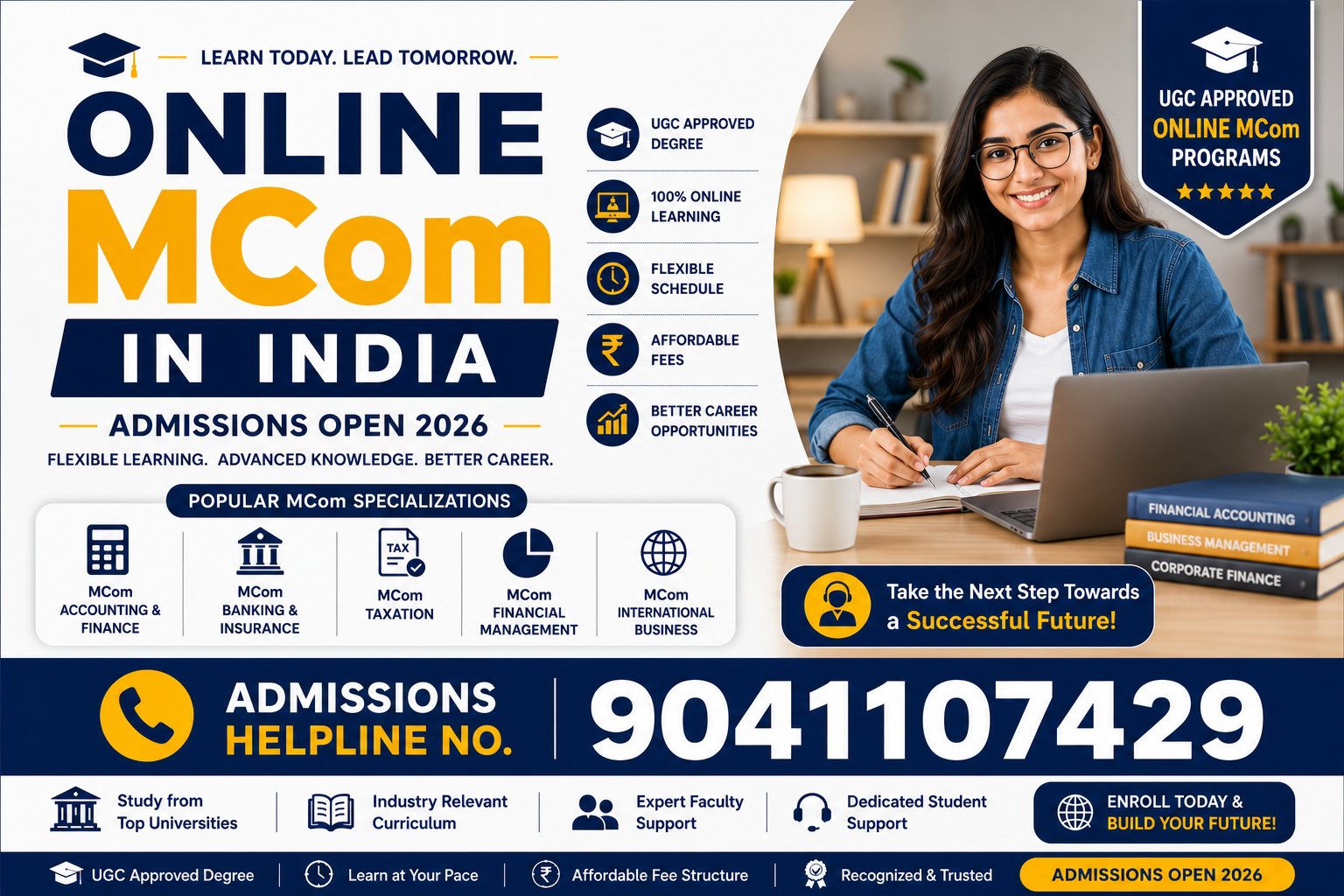
The demand for flexible and career-oriented higher education is increasing rapidly in India. An Online MCom (Master of Commerce) has become a preferred choice for commerce graduates, working professionals, entrepreneurs, and individuals looking to enhance their knowledge in finance, accounting, taxation, banking, and business management.
Admission Helpline No. : +91 90411 07429

With the convenience of online learning, students can pursue a recognized postgraduate degree without attending regular classroom sessions. If you are planning to enroll in an Online MCom program in 2026, this comprehensive step-by-step guide will help you understand the admission process, eligibility requirements, fees, specializations, and career opportunities.
What is an Online MCom?
An Online MCom (Master of Commerce) is a two-year postgraduate degree program delivered through digital learning platforms. Students can attend live classes, watch recorded lectures, submit assignments online, and appear for examinations according to university guidelines.
The program focuses on advanced concepts in commerce, accounting, finance, taxation, economics, business law, and management.
Why Choose an Online MCom?
Flexible Learning
Students can study from anywhere and manage their education alongside work or personal commitments.
Affordable Fee Structure
Online MCom programs are generally more affordable than traditional campus-based courses.
Career Advancement
An MCom degree helps students gain advanced knowledge and improve their opportunities for promotions and higher-paying roles.
Learn While Working
Working professionals can continue their jobs while pursuing higher education.
Industry-Relevant Curriculum
Universities regularly update their curriculum to meet current industry and business requirements.
Eligibility Criteria for Online MCom Admission 2026
Most universities require:
- A Bachelor’s degree from a recognized university.
- BCom, BBA, BA, BSc, or equivalent qualification.
- Minimum qualifying marks as specified by the university.
- Final-year students may also apply in some universities.
- No upper age limit for admission.
Popular Online MCom Specializations
Students can choose from various specializations including:
MCom in Accounting and Finance
Focuses on financial reporting, accounting principles, auditing, and financial management.
MCom in Banking and Insurance
Provides knowledge of banking operations, risk management, and insurance practices.
MCom in Taxation
Covers direct taxation, indirect taxation, GST, and tax planning.
MCom in Financial Management
Emphasizes investment analysis, corporate finance, and financial decision-making.
MCom in International Business
Focuses on global trade, international marketing, and cross-border business operations.
Admission Helpline No. : +91 90411 07429
Step-by-Step Online MCom Admission Process 2026
Step 1: Choose the Right University
Compare universities based on:
- UGC recognition
- NAAC accreditation
- Faculty expertise
- Placement support
- Student reviews
- Learning Management System (LMS)
- Fee structure
Step 2: Select Your Specialization
Choose a specialization according to your career interests and future goals.
Step 3: Fill the Online Application Form
Complete the application form by providing:
- Personal details
- Academic qualifications
- Contact information
- Preferred specialization
Step 4: Upload Required Documents
Generally required documents include:
- 10th Marksheet
- 12th Marksheet
- Graduation Marksheets
- Degree Certificate
- Aadhaar Card or Government ID
- Passport Size Photograph
- Signature
Step 5: Pay Application Fee
Most universities offer online payment methods such as:
- UPI
- Debit Card
- Credit Card
- Net Banking
Step 6: Document Verification
The university verifies the submitted documents and eligibility criteria.
Step 7: Admission Confirmation
Upon successful verification, students receive admission confirmation and enrollment details.
Step 8: Access the Learning Portal
Students receive LMS access where they can:
- Attend live classes
- Watch recorded lectures
- Submit assignments
- Download study material
- Track academic progress
Admission Helpline No. : +91 90411 07429
Online MCom Fees in India
The fee structure varies depending on the university.
Typical fee ranges:
| University Type | Approximate Fees |
|---|---|
| Government Universities | ₹20,000 – ₹60,000 |
| Private Universities | ₹40,000 – ₹1,50,000 |
| Premium Online Universities | ₹80,000 – ₹2,00,000 |
Many universities also offer EMI facilities and scholarships.
Career Opportunities After Online MCom
An Online MCom degree can lead to various career opportunities, including:
- Accountant
- Financial Analyst
- Tax Consultant
- Banking Professional
- Investment Analyst
- Auditor
- Finance Manager
- Business Consultant
- Corporate Accountant
- Financial Planner
Graduates can work in banking, finance, insurance, taxation, consulting, education, and corporate sectors.
Benefits of Pursuing an Online MCom in 2026
- Flexible study schedule
- Affordable education
- Industry-focused curriculum
- Better career prospects
- Opportunity to work while studying
- Access to experienced faculty
- UGC-recognized degree options
Tips for Choosing the Best Online MCom University
Before taking admission, consider:
- UGC approval status
- NAAC accreditation
- Placement assistance
- Alumni network
- Faculty quality
- Student support services
- Fee affordability
- Industry recognition
Selecting the right university can significantly enhance the value of your degree and future career prospects.
Conclusion
An Online MCom is an excellent option for students and professionals looking to build expertise in commerce, finance, accounting, taxation, and business management. With flexible learning, affordable fees, and growing industry acceptance, Online MCom programs have become one of the most popular postgraduate courses in India.
Admission Helpline No. : +91 90411 07429
By following this step-by-step admission guide, you can confidently choose the right university, complete the admission process, and take a significant step toward achieving your academic and professional goals in 2026.








 Collegekampus.com