

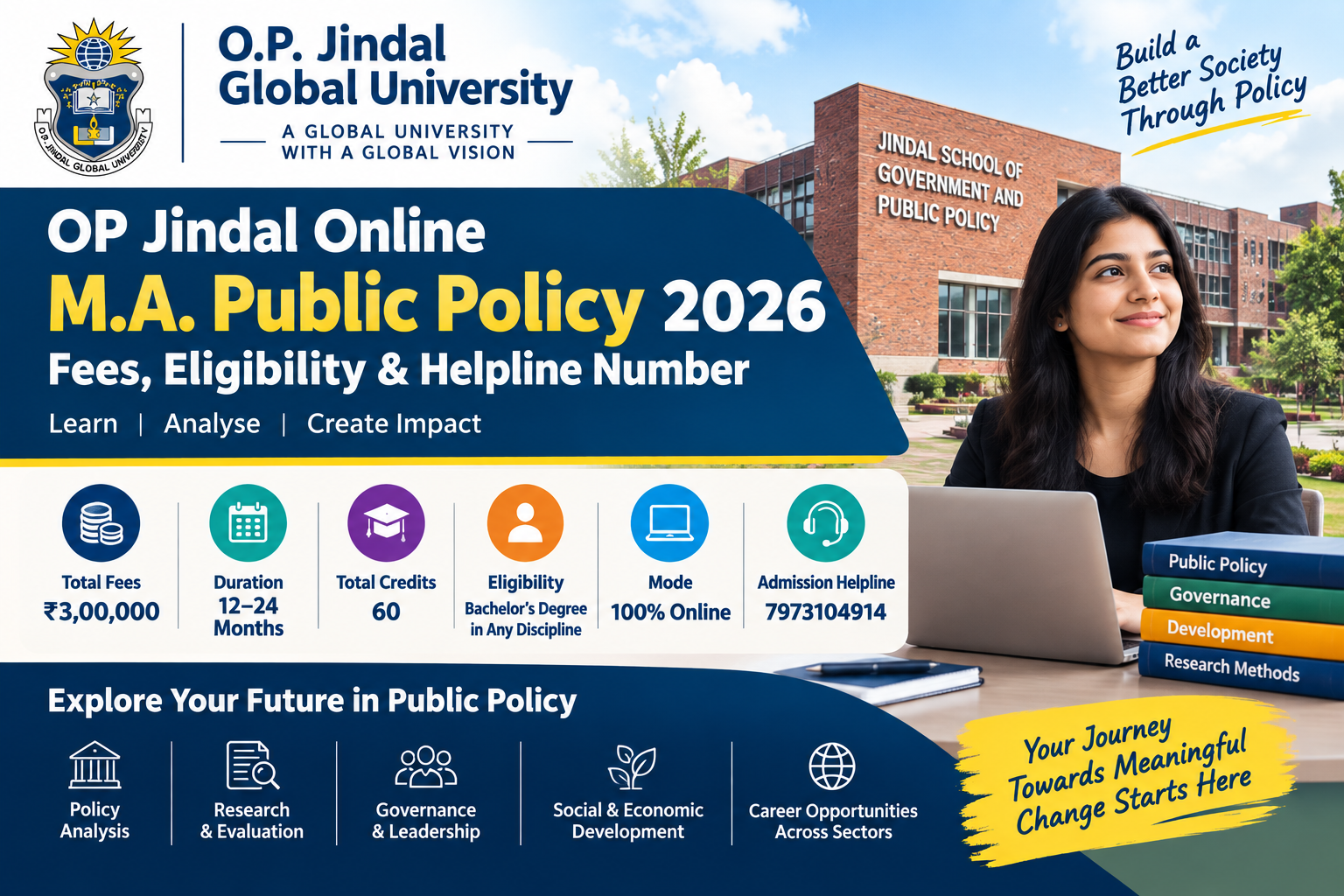
Public policy plays an important role in shaping a country’s economy, education system, healthcare services, environmental protection, employment opportunities, and social development. As governments, businesses, non-governmental organisations, and international institutions increasingly rely on research and data to make decisions, professionals with public policy knowledge can explore opportunities across several sectors.
For admission assistance and guidance, contact 7973104914.
The OP Jindal Online M.A. Public Policy 2026 programme is designed for graduates and working professionals who want to understand how public policies are developed, implemented, monitored, and evaluated. The programme combines policy concepts with research, governance, economic analysis, and practical approaches to addressing social and institutional challenges.
If you are planning to pursue a postgraduate degree in public policy, this guide explains the programme’s fees, eligibility criteria, duration, curriculum, admission process, career opportunities, and other important details.
For admission guidance, programme information, and application assistance, you can contact the admission assistance helpline at 7973104914.
OP Jindal Online M.A. Public Policy 2026: Programme Highlights
Before applying, students should understand the basic details of the programme.
| Particulars | Details |
|---|---|
| Programme Name | M.A. in Public Policy |
| University | O.P. Jindal Global University |
| School | Jindal School of Government and Public Policy |
| Study Mode | Online |
| Programme Duration | 12–24 months |
| Total Credits | 60 credits |
| Total Tuition Fee | ₹3,00,000 |
| Eligibility | Bachelor’s degree in any discipline from a recognised university |
| Learning Areas | Governance, policy analysis, research, economics and social policy |
| Learning Format | Online learning with study materials, activities and discussions |
| Admission Assistance Helpline | 7973104914 |
Note: Programme details, fees, admission requirements, and available intake dates may change. Confirm the latest information before submitting an application.
What Is OP Jindal Online M.A. Public Policy?
The Online M.A. Public Policy is a postgraduate programme that focuses on the processes and institutions involved in developing and implementing public policies. It helps learners understand how governments and other organisations respond to social, economic, political, and environmental challenges.
Public policy is not limited to government departments. It also involves research institutions, consulting firms, development organisations, think tanks, non-profit organisations, corporate social responsibility teams, and international agencies.
For example, a public policy professional may analyse why a government scheme is not reaching its intended beneficiaries, evaluate whether an education initiative is improving student outcomes, study the economic impact of a proposed regulation, or recommend improvements to a public healthcare programme.
The programme is intended to help learners develop an analytical understanding of these issues and explore how evidence can support better decisions.
Why Choose OP Jindal Online M.A. Public Policy in 2026?
Choosing the right postgraduate programme is an important decision. Students should consider the curriculum, learning flexibility, fees, career goals, and admission requirements before enrolling.
1. Study Public Policy Through an Interdisciplinary Approach
Public policy involves several connected subjects, including economics, politics, sociology, governance, statistics, law, and public administration. An interdisciplinary programme helps students examine policy challenges from different perspectives instead of relying on a single subject area.
2. Learn About Real-World Policy Challenges
Public policy decisions can affect employment, healthcare, education, urban development, poverty reduction, and environmental sustainability. Studying these areas can help learners understand how policies are designed and why implementation and evaluation are important.
3. Flexible Online Learning
The online format can be useful for students who want to continue working or manage other responsibilities while studying. Learners can access the programme remotely rather than relocating for a conventional full-time campus programme.
Students should still plan their weekly study schedule carefully because online learning requires consistent participation, independent reading, assignment completion, and preparation.
4. Develop Research and Analytical Skills
Public policy work often involves reviewing reports, interpreting data, identifying problems, evaluating outcomes, and presenting recommendations. The programme’s research-oriented learning can help students develop these skills.
5. Explore Public and Private Sector Opportunities
Public policy knowledge may be relevant to government-related projects, non-profit organisations, policy research, development programmes, consulting, corporate social responsibility, and public affairs.
Career outcomes depend on a candidate’s previous education, skills, experience, professional network, and the requirements of individual employers.
OP Jindal Online M.A. Public Policy Fees 2026
The listed total tuition fee for the online M.A. Public Policy programme is ₹3,00,000.
The published fee structure divides the tuition payment into three parts.
| Fee Component | Amount |
|---|---|
| Registration Fee | ₹50,000 |
| First Instalment | ₹1,25,000 |
| Second Instalment | ₹1,25,000 |
| Total Tuition Fee | ₹3,00,000 |
Students should check the latest fee schedule and payment deadlines before accepting an admission offer. Any additional charges, payment-plan terms, or financing conditions should be confirmed directly with the university or the relevant programme representative.
Is the Fee Paid in One Payment?
The published fee structure lists a registration payment and two subsequent instalments. This can help students plan their education budget in advance.
Before making a payment, check:
- The amount payable when accepting the offer.
- The deadline for each instalment.
- The payment methods available.
- The refund and cancellation policy.
- Whether any financing facility is available and what its terms are.
Students should rely on the current written fee schedule for the final payable amount.
OP Jindal Online M.A. Public Policy Eligibility Criteria 2026
The programme is designed for graduates from different academic backgrounds.
Educational Qualification
Applicants generally need a bachelor’s degree in any discipline from a recognised university in India or abroad.
Depending on the current admission requirements, eligible applicants may come from fields such as:
- Political Science
- Economics
- Sociology
- History
- Public Administration
- Law
- Commerce
- Business Administration
- Engineering
- Computer Science
- Journalism and Mass Communication
- Other recognised undergraduate disciplines
A previous degree in public policy or social sciences is not necessarily required under the published programme criteria. This makes the programme relevant to applicants who want to transition into policy-related work from another academic or professional field.
Is Work Experience Mandatory?
Work experience is not listed as a mandatory requirement in the published online programme information. Both recent graduates and working professionals may consider the programme, subject to the university’s current admission process.
Is There an Age Limit?
Check the latest admission requirements for any applicable conditions. Applicants should not assume that an age-related rule applies unless it is specified in the current programme documentation.
Documents Required for Admission
Applicants should prepare the following documents, as applicable:
- Bachelor’s degree certificate or provisional certificate.
- Undergraduate academic transcripts or marksheets.
- Valid government-issued identification.
- Passport or other permitted identification for international applicants.
- Statement of purpose or written admission responses, if required.
- Any additional documents requested by the admissions team.
Document requirements may vary according to the applicant’s academic background and the current admission process.
OP Jindal Online M.A. Public Policy Duration 2026
The online programme is listed with a flexible completion period of approximately 12 to 24 months.
The actual time required may depend on the learner’s pace, weekly availability, course schedule, and assessment requirements.
Students should plan their time realistically. Although online learning offers flexibility, postgraduate study still involves reading, assignments, research, discussions, and independent preparation.
The programme information indicates an estimated study commitment of around 15–18 hours per week. Applicants should consider this commitment before enrolling, particularly if they are working full-time or managing other responsibilities.
OP Jindal Online M.A. Public Policy Syllabus 2026
The programme focuses on understanding policy challenges, analysing evidence, and evaluating policy decisions. Its interdisciplinary approach connects governance, economics, research methods, and social development.
The exact course selection and availability should be confirmed through the current curriculum.
1. Foundations of Public Policy
This area introduces the meaning, scope, and importance of public policy. Students explore how public problems are identified, how policy agendas are formed, and how institutions influence policy decisions.
2. Social Foundations of Public Policy
Public policies operate within complex societies. This area examines social structures, inequalities, institutions, and the ways public decisions affect different communities.
3. Economics and Public Policy
Economic concepts are useful for understanding public spending, taxation, employment, resource allocation, market regulation, and development. Students can explore how economic analysis supports the evaluation of policy options.
4. Research Methods
Research is important for understanding public problems and assessing whether proposed solutions are effective. Research methods help students frame questions, review existing evidence, collect information, and interpret findings.
5. Methods of Impact Evaluation
Impact evaluation examines whether a programme or intervention has produced the intended results. This knowledge can be relevant to development projects, education initiatives, healthcare programmes, and other public interventions.
6. Urbanisation and Development
Urbanisation creates opportunities as well as challenges involving housing, transport, infrastructure, sanitation, employment, and access to public services. This subject area helps learners examine the relationship between urban growth and development policy.
7. Introduction to Health Policy
Health policy involves healthcare access, financing, public health systems, service delivery, and the allocation of limited resources. Studying this area can help learners understand how policy decisions affect public health outcomes.
8. Behavioural Economics for Development Policy
Behavioural economics considers how people make decisions in real-world situations. This perspective can help policymakers design programmes that account for behavioural patterns, incentives, and barriers to participation.
9. Identity and Policy
Public policies can affect communities differently depending on social, cultural, economic, and institutional circumstances. This area encourages learners to consider inclusion, representation, and the distribution of policy outcomes.
10. Data Analytics and Policy Design
The programme provides opportunities to explore focused learning through areas such as data analytics and policy design. These areas are relevant to evidence-based decision-making, policy assessment, and the development of practical solutions.
11. Research and Dissertation Options
A dissertation option can provide an opportunity to study a policy question in depth and develop independent research skills. Students interested in research-based roles should review the current dissertation requirements and available academic guidance.
The subjects above describe key curriculum areas associated with the programme. They should not be treated as a guaranteed semester-by-semester course list; the university’s current curriculum determines the final course structure.
Specialisation and Elective Options
Students may be able to shape parts of their learning around particular interests. Published programme information highlights the following areas:
Data Analytics
Data analytics is relevant to policy research, programme evaluation, statistical analysis, and evidence-based decision-making. Learners interested in research or evaluation roles may find this area useful.
Policy Design
Policy design focuses on identifying problems, comparing possible solutions, considering implementation challenges, and developing approaches that respond to public needs.
Cross-Electives in International Relations
Depending on the available course options, learners may have opportunities to study subjects connected to international relations. This may be useful for those interested in international development, global governance, or policy issues that cross national boundaries.
Availability of electives and specialisation pathways should be verified for the relevant intake.
Skills You Can Develop Through the Programme
The value of a postgraduate programme depends not only on its qualification but also on the knowledge and practical skills students develop.
The M.A. Public Policy curriculum can help learners strengthen several capabilities.
Policy analysis: Understanding policy problems, reviewing existing approaches, and comparing possible solutions.
Research and evidence evaluation: Reading reports critically, examining data, and using evidence to support conclusions.
Critical thinking: Identifying assumptions, assessing arguments, and considering the possible consequences of policy decisions.
Programme evaluation: Understanding how initiatives are monitored and how their outcomes can be assessed.
Communication: Presenting research findings, explaining recommendations, and preparing clear written reports.
Problem-solving: Examining complex social or institutional issues and considering practical responses.
Governance awareness: Understanding how institutions, stakeholders, and implementation systems influence policy outcomes.
These capabilities can be relevant across research, development, consulting, public affairs, and programme-management environments.
OP Jindal Online M.A. Public Policy Career Opportunities
Students often consider a public policy degree because they want to work on social, economic, institutional, or governance-related challenges.
The programme may support applications for a variety of roles, depending on an individual’s previous qualifications and experience.
1. Policy Analyst
Policy analysts study public issues, review evidence, compare policy alternatives, and prepare recommendations. They may work with research organisations, consulting firms, public bodies, or development institutions.
2. Research Associate
Research associates assist with literature reviews, data collection, interviews, report preparation, and analysis. The role can be suitable for graduates interested in policy research or further academic study.
3. Public Policy Consultant
Policy consultants may help organisations evaluate programmes, understand regulatory developments, review policy options, and develop recommendations. Relevant experience and analytical skills can be important for these positions.
4. Programme Manager
Programme managers coordinate projects, manage timelines, work with stakeholders, monitor progress, and support the achievement of programme objectives. Policy knowledge may be valuable in development and social-impact projects.
5. Monitoring and Evaluation Professional
Monitoring and evaluation professionals assess whether programmes are being implemented as planned and whether they are achieving intended outcomes. Their work can involve indicators, surveys, data analysis, and reporting.
6. Development Sector Professional
Non-profit organisations and development agencies may recruit professionals to support projects involving education, health, livelihoods, poverty reduction, gender inclusion, and community development.
7. Corporate Social Responsibility Professional
CSR teams plan and monitor social-impact initiatives. Public policy knowledge can help professionals understand community needs, programme design, stakeholder relationships, and impact measurement.
8. Public Affairs and Government Relations Professional
Some organisations need professionals who can analyse regulatory developments, understand government priorities, and communicate with stakeholders. Relevant experience and subject knowledge may be important for these roles.
9. Think Tank and Advocacy Researcher
Think tanks and advocacy organisations conduct research, publish reports, evaluate policy decisions, and contribute to public debate. Research, writing, and analytical abilities are particularly relevant.
10. Academic and Further Research Pathways
Graduates who develop a strong research interest may consider further study or research-oriented roles, subject to the entry requirements of the institution or employer.
Important: A master’s degree does not guarantee a particular job, salary, or placement. Outcomes depend on experience, skills, location, employer requirements, and the opportunities available when a candidate applies.
Who Should Consider OP Jindal Online M.A. Public Policy?
The programme may be worth considering for several groups.
Recent graduates: Students who want to explore governance, development, policy research, or public affairs after completing a bachelor’s degree.
Working professionals: Employees who want to strengthen their understanding of public policy while continuing their current employment.
Development sector professionals: People involved in community projects, non-profit organisations, social-impact programmes, or development initiatives.
Researchers and aspiring analysts: Learners interested in studying public problems, interpreting evidence, and preparing policy recommendations.
Professionals considering a career transition: Graduates from other disciplines who want to explore policy-related work and meet the programme’s eligibility requirements.
Before applying, candidates should compare the curriculum with their long-term career goals and consider whether the time commitment fits their schedule.
How to Apply for OP Jindal Online M.A. Public Policy Admission 2026
The admission process may involve the following steps. Applicants should follow the current instructions issued for their intake.
Step 1: Review the Programme
Read the programme details, curriculum, duration, fees, and eligibility criteria. Confirm that the course matches your educational background and career interests.
Step 2: Prepare Your Documents
Keep your undergraduate marksheets, degree documents, identification, and any requested admission materials ready.
Step 3: Complete the Application
Fill in the application form using accurate personal and academic information. Review every section before submission.
Step 4: Prepare the Required Written Responses
The admission process may ask applicants to provide a written statement about their academic interests, long-term career goals, and reasons for choosing public policy.
Applicants may also be asked to discuss a public policy implemented in their country in recent years and explain its significance. If such a question is included in the current application, prepare a well-reasoned response supported by relevant examples.
Step 5: Submit the Application
Submit the form and required documents according to the current application instructions. Check for any follow-up communication or additional requirements.
Step 6: Review the Admission Offer
If selected, carefully review the offer, fee schedule, payment deadlines, and enrolment conditions before accepting.
Step 7: Plan Your Studies
Once enrolled, organise a weekly schedule for lectures, reading, research, discussions, and assessments.
Is Admission Open for OP Jindal Online M.A. Public Policy 2026?
Admission availability depends on the intake and the university’s current schedule. The published information for the October 2026 cohort listed a start date of 1 October 2026 and a final application deadline of 30 September 2026. Those dates have passed.
Applicants looking to enrol now should contact the university or its admissions team to confirm whether late applications are possible, whether a later intake is available, and when the next application window will open. Do not rely on older promotional material to assume that an intake is still accepting applications.
For admission guidance, you can also contact the admission assistance helpline at 7973104914.
Is OP Jindal Online M.A. Public Policy Suitable for Working Professionals?
The online format may be convenient for professionals who cannot attend regular on-campus classes. It can allow learners to continue working while building knowledge in policy analysis, research, governance, and programme evaluation.
However, online study still requires discipline. Learners should consider the expected weekly commitment, assessment deadlines, and any scheduled interactive sessions before enrolling.
Working professionals may benefit from connecting programme topics with practical issues they encounter in their own sectors. For example, a person working in education may explore education policy, while someone in healthcare may be interested in health systems or public service delivery.
OP Jindal Online M.A. Public Policy vs. Political Science
Public policy and political science are related fields, but they do not have exactly the same focus.
| Feature | Public Policy | Political Science |
|---|---|---|
| Main Focus | Policy design, implementation, and evaluation | Political systems, institutions, ideas, and behaviour |
| Common Questions | Does a policy work? How can it be improved? | How do political institutions and systems operate? |
| Key Skills | Policy analysis, research, evaluation, evidence-based recommendations | Political analysis, theory, institutional and comparative study |
| Potential Work Areas | Policy research, programme evaluation, development, consulting | Political research, public affairs, academic and related roles |
There is overlap between the subjects. The right option depends on whether a student is more interested in understanding political systems or analysing how policies can address practical public problems.
Advantages of Studying Public Policy in 2026
Public policy knowledge can be relevant to many contemporary challenges.
- Education: Improving access, quality, affordability, and learning outcomes.
- Healthcare: Understanding healthcare delivery, financing, and public health systems.
- Climate and environment: Analysing sustainability initiatives and environmental regulations.
- Urban development: Examining housing, transport, sanitation, and infrastructure.
- Economic development: Studying employment, inequality, resource allocation, and development programmes.
- Digital governance: Considering the impact of technology, data, and digital public services.
- Social inclusion: Evaluating how public programmes reach different communities.
A policy degree does not automatically make someone an expert in every sector. However, the research and analytical foundations can help learners build specialised knowledge over time.
OP Jindal Online M.A. Public Policy Admission Assistance Helpline
Students may have questions about eligibility, fees, documents, admission procedures, and intake dates before applying.
For admission guidance and assistance with understanding the application process, contact:
Admission Assistance Helpline: 7973104914
Before making a decision, confirm the current fee structure, intake availability, and programme requirements. Use the university’s latest written information to verify all admission-related details.
Frequently Asked Questions (FAQs)
1. What is the total fee for OP Jindal Online M.A. Public Policy 2026?
The listed total tuition fee is ₹3,00,000. The published structure includes a ₹50,000 registration fee and two instalments of ₹1,25,000 each. Confirm the latest schedule before payment.
2. What is the duration of the programme?
The online programme is listed with a flexible duration of 12–24 months, depending on the learner’s pace and programme requirements.
3. What is the eligibility for OP Jindal Online M.A. Public Policy?
Applicants generally need a bachelor’s degree in any discipline from a recognised university in India or abroad. Check the current admission criteria before applying.
4. Can students from a non-social-science background apply?
The published eligibility information accepts an undergraduate degree in any discipline. Applicants from fields such as commerce, business, engineering, law, and other areas may therefore consider applying, subject to the current requirements.
5. Is work experience compulsory?
Work experience is not listed as a mandatory requirement in the published programme information. Candidates should verify the current criteria for their intake.
6. Is the programme available online?
Yes, the programme is offered in an online format. Students should review the current course structure and participation requirements to understand how learning and assessments are delivered.
7. What is the weekly study commitment?
The published programme information estimates approximately 15–18 hours per week. Individual requirements may vary according to a student’s pace and workload.
8. What subjects are covered in the curriculum?
The curriculum covers areas related to public policy, social foundations, economics, research methods, impact evaluation, urbanisation and development, health policy, behavioural economics, and other policy-related subjects. The final course list depends on the current curriculum.
9. What jobs can I pursue after completing the degree?
Possible career directions include policy analyst, research associate, programme manager, monitoring and evaluation professional, development sector professional, CSR professional, public affairs professional, and policy consultant. Actual eligibility for these roles depends on the employer and the candidate’s skills and experience.
10. Is admission still open for the October 2026 intake?
The published October 2026 deadline was 30 September 2026, and the listed start date was 1 October 2026. Both dates have passed. Contact the university to confirm whether any late admission option or subsequent intake is available.
11. What documents should I prepare?
Applicants should generally prepare their undergraduate academic records, degree or provisional certificate, valid government-issued identification, and any written admission responses requested in the application process.
12. What is the admission assistance helpline number?
For admission guidance, contact 7973104914.
Conclusion
The OP Jindal Online M.A. Public Policy 2026 programme may be a relevant option for graduates and working professionals who want to develop knowledge of governance, public policy, research, and evidence-based decision-making. With a listed tuition fee of ₹3,00,000, an online learning format, and a flexible duration of 12–24 months, it offers a pathway for learners interested in policy-related academic and professional development.
Before applying, review the current curriculum, verify your eligibility, check the latest fee schedule, and confirm the next available intake. Careful planning can help you decide whether the programme fits your education budget and long-term career goals.







 Collegekampus.com