
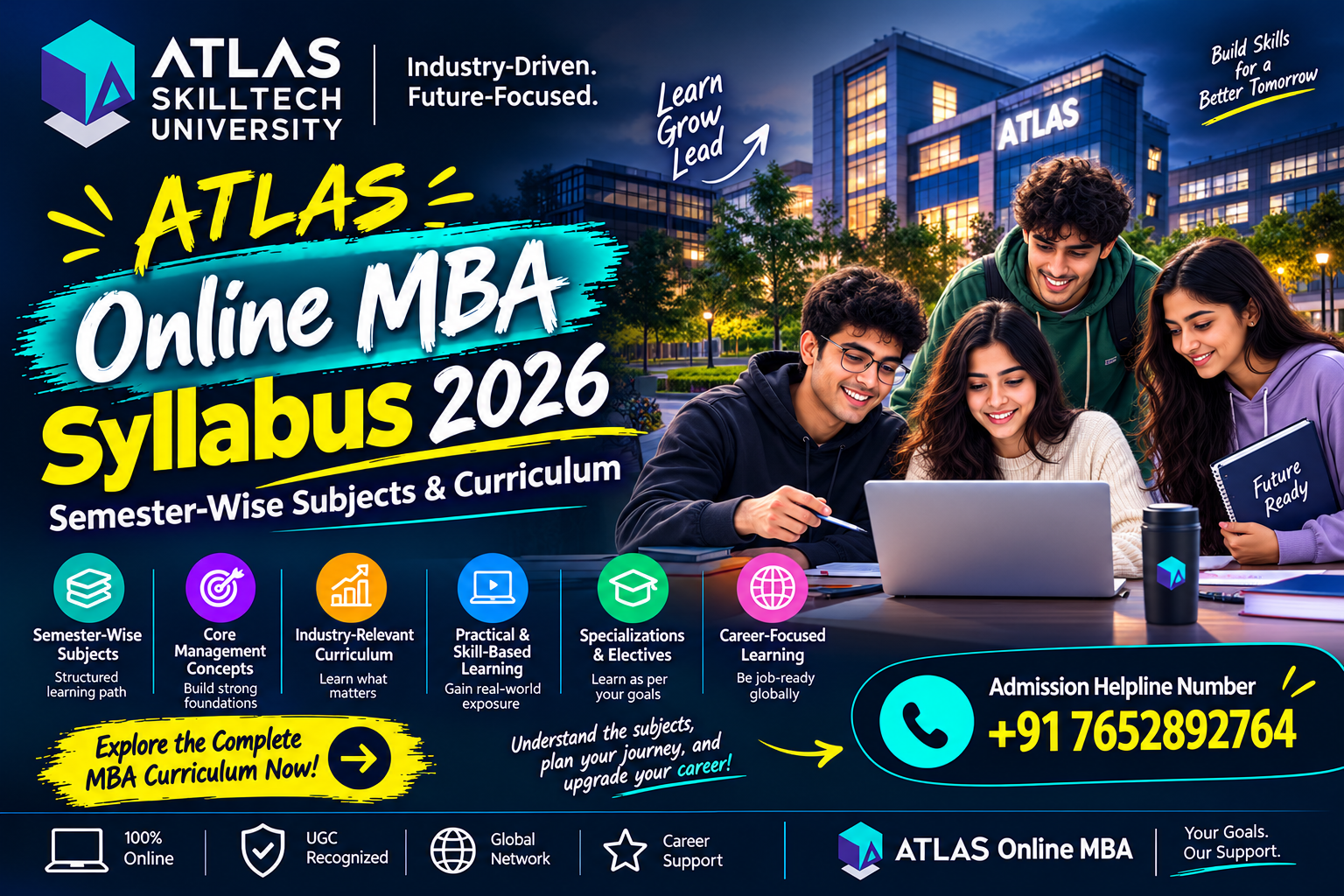
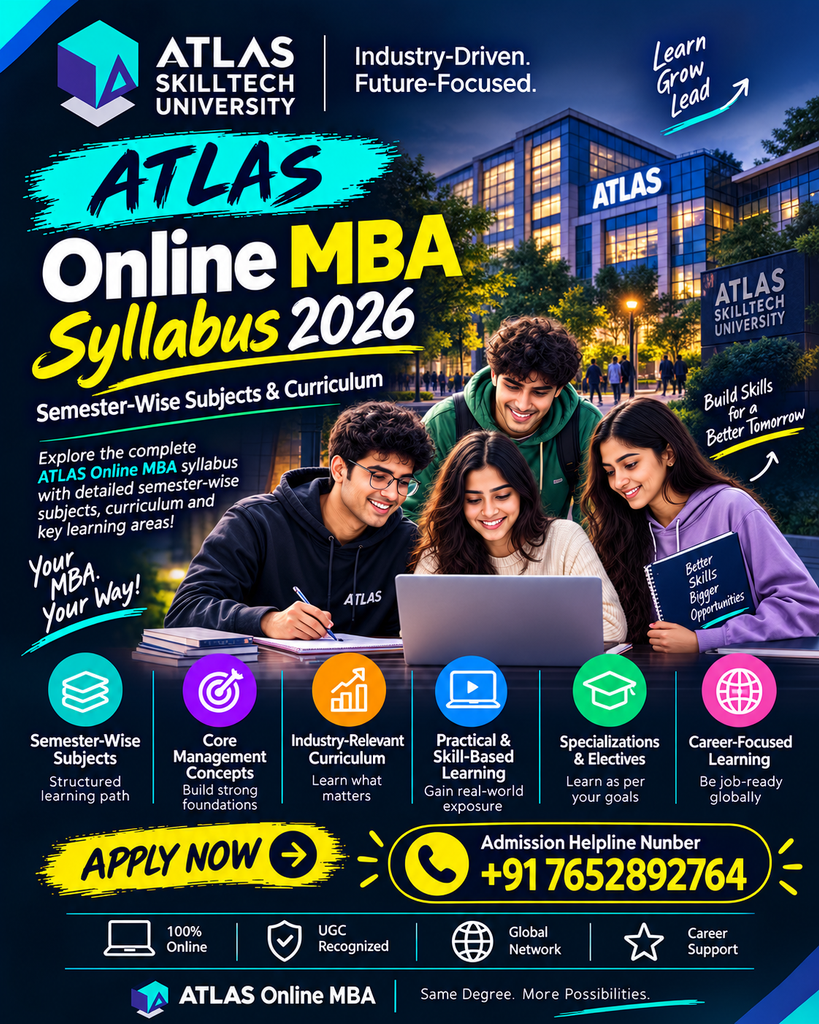
The ATLAS Online MBA Syllabus 2026 is designed for graduates, working professionals, entrepreneurs, and future business leaders who want to develop modern management skills through an online learning format. The curriculum combines core business concepts with artificial intelligence, digital marketing, analytics, communication, entrepreneurship, leadership, and practical business learning.
The ATLAS Online MBA Syllabus 2026 is structured across four semesters and carries a total of 87 credits. The program is designed as a two-year online MBA, while the flexible structure can provide additional time for eligible learners who need a slower pace. The curriculum focuses not only on theoretical business concepts but also on practical skills, AI-powered tools, data interpretation, decision-making, strategic thinking, and professional development.
For students planning to take admission, understanding the ATLAS Online MBA Syllabus 2026 is important because the subjects studied during each semester can influence their skills, specialization direction, projects, and future career plans.

ATLAS Online MBA Admission Helpline Number: +91 7652892764
ATLAS Online MBA Syllabus 2026: Quick Overview
The ATLAS Online MBA Syllabus 2026 covers management fundamentals as well as emerging business and technology skills.
| Particular | Details |
|---|---|
| Program | Online MBA |
| University | ATLAS SkillTech University |
| Mode | Online |
| Duration | 2 Years |
| Total Semesters | 4 |
| Total Credits | 87 |
| Learning Format | Live + Flexible |
| Focus | Business, Management, AI & Practical Skills |
| Designed For | Graduates & Working Professionals |
| Semester Fee | ₹62,500 |
| Total Program Fee | ₹2,50,000 |
| Registration Fee | ₹1,000 |
The curriculum and subject combinations may be updated according to academic and industry requirements. Students should review the applicable curriculum for their admission batch before finalizing their course choices.
What Is the ATLAS Online MBA Syllabus 2026?
The ATLAS Online MBA Syllabus 2026 is the semester-wise academic structure of the online Master of Business Administration program.
The curriculum is designed around modern business requirements. Instead of focusing only on conventional management subjects, the program introduces students to areas such as artificial intelligence, digital marketing, analytics, business research, data storytelling, predictive modelling, cybersecurity, corporate strategy, supply chain analytics, and professional leadership.
The program also emphasizes practical learning. Students can work on projects, business problems, AI-powered activities, industry-oriented assignments, and other experiential learning activities.
This approach can be useful for students who want to understand how management concepts are applied in modern organizations.
The ATLAS Online MBA Syllabus 2026 also includes professional communication and career development components throughout the program, helping students develop skills beyond traditional textbook-based learning.
ATLAS Online MBA Syllabus 2026 Semester-Wise Structure
The online MBA is divided into four semesters.
The broad structure can be understood as:
- Semester 1: Business foundations, marketing, finance, entrepreneurship, AI tools and communication
- Semester 2: Business research, analytics, predictive modelling, data storytelling and professional development
- Semester 3: Advanced business applications, economics, cybersecurity, machine learning, SQL and internship/dissertation
- Semester 4: Corporate strategy, governance, supply chain analytics, Python, responsible AI and advanced business applications
The program carries 87 credits across four semesters.
Semester 1: ATLAS Online MBA Syllabus 2026
The first semester of the ATLAS Online MBA Syllabus 2026 introduces students to important business fundamentals.
Semester 1 carries 21 credits and includes seven major courses.
1. Geopolitics & International Business
This subject introduces students to the relationship between global politics, economics, international markets, and business decisions.
Students can learn how geopolitical developments may affect companies, international trade, global markets, supply chains, and business strategies.
Understanding international business is useful for students who want to work with multinational organizations or businesses operating across different markets.
2. Financial Statement Analysis
Financial Statement Analysis helps students understand financial information and evaluate the financial performance of an organization.
Students can learn how to interpret financial statements and use financial information to support business decisions.
This subject is useful not only for finance professionals but also for managers because business decisions frequently involve financial performance and resource allocation.
3. The 21st Century Marketing
Modern marketing is very different from traditional marketing.
This subject focuses on contemporary marketing concepts, customer behaviour, market trends, branding, digital transformation, and changing consumer expectations.
Students can understand how organizations use modern marketing strategies to attract customers, build brands, and compete in changing markets.
4. Entrepreneurship & Family Business 101
Entrepreneurship and family business education introduces students to entrepreneurial thinking and business development.
Students can learn about opportunity identification, innovation, business models, entrepreneurial decision-making, and family-managed organizations.
This subject can be especially useful for aspiring entrepreneurs and students who plan to join or expand a family business.
5. Driving Decisions by Excel & Modern Age AI Tools
One of the distinctive elements of the ATLAS Online MBA Syllabus 2026 is its focus on AI and practical digital tools.
This subject introduces students to Excel-based decision-making and modern AI tools.
Students can develop skills related to data organization, analysis, productivity, decision support, and technology-assisted business problem solving.
6. Introduction to Digital Marketing
Digital marketing is an important component of modern business.
This subject introduces students to digital marketing concepts and the changing digital customer journey.
Students can develop an understanding of digital channels, online customer engagement, digital campaigns, and technology-driven marketing strategies.
7. Professional Communication and Presentation Skills – Career and Leadership Development I
Communication is an essential management skill.
This course focuses on professional communication, presentation abilities, career development, and leadership skills.
Students can develop confidence in presenting ideas, communicating with stakeholders, and participating in professional environments.
ATLAS Online MBA Syllabus 2026 admission assistance: +91 7652892764
Semester 2: ATLAS Online MBA Syllabus 2026
Semester 2 moves toward more advanced analytical, professional, and business-oriented learning.
The ATLAS Online MBA Syllabus 2026 for this semester can include areas such as:
- CSR, SDGs & Business Research
- Managing Self and People Skills with Human-Centered Design Thinking
- Statistics for Business Managers
- Decision Making through Predictive Modelling
- Business Analytics Using R
- Data Storytelling
- Multidisciplinary Elective
The second semester is particularly relevant for students who want to develop analytical and decision-making capabilities.
CSR, SDGs & Business Research
This subject introduces students to corporate social responsibility, sustainability, Sustainable Development Goals, and business research.
Modern organizations are increasingly expected to consider environmental, social, and governance factors in their decisions.
Students can understand how research and responsible business practices can support organizational development.
Managing Self and People Skills with Human-Centered Design Thinking
This subject combines personal development, people skills, leadership, and human-centered problem solving.
Students can learn how empathy and design thinking can be used to understand users, employees, customers, and stakeholders.
This can help students develop a more practical approach to solving organizational and business problems.
Statistics for Business Managers
Statistics is important for business decision-making.
Students can learn how statistical concepts can be applied to business information, trends, performance data, and decision-making.
The subject helps learners become more comfortable with data-driven business analysis.
Decision Making Through Predictive Modelling
Predictive modelling focuses on using data to estimate possible future outcomes.
Students can learn how predictive approaches can support business decisions, forecasting, risk analysis, and strategic planning.
This subject is particularly relevant in an environment where organizations increasingly depend on data and technology.
Business Analytics Using R
R is widely used for data analysis and statistical computing.
Students can learn how R can be applied to business analytics, data manipulation, visualization, and analytical modelling.
Developing these skills can be useful for students interested in business analytics and data-driven management.
Data Storytelling
Data alone may not always communicate a clear business message.
Data storytelling teaches students how to convert analytical findings into understandable narratives using context, visualization, and communication.
This skill can be useful for managers who need to explain data and recommendations to teams and decision-makers.
Semester 3: ATLAS Online MBA Syllabus 2026
Semester 3 moves further into advanced business, technology, analytics, and practical learning.
The ATLAS Online MBA Syllabus 2026 at this stage includes areas such as:
- Organizational Behaviour & Human Values
- Career and Leadership Development III
- Economics and Cyber Governance
- Internship Dissertation
- Machine Learning for Managers
- Vibe Coding for Managers
- Analytics for Sustainability Management
- SQL for Managers
- Multidisciplinary Elective
Semester 3 is important because students begin working with more advanced technology and business applications.
Organizational Behaviour & Human Values
Organizational Behaviour helps students understand how individuals and teams behave within organizations.
The subject can cover areas such as leadership, teamwork, organizational culture, employee behaviour, motivation, and decision-making.
Understanding organizational behaviour can help future managers work more effectively with people.
Economics and Cyber Governance
This course combines business economics with cybersecurity and digital governance.
Organizations increasingly depend on digital systems, making cybersecurity an important management concern.
Students can develop awareness of economic decision-making, digital risks, governance, and responsible technology use.
Internship Dissertation
The internship dissertation provides students with an opportunity to apply their academic knowledge to practical business situations.
Students can gain exposure to real-world business problems while developing research and analytical abilities.
Practical projects can also help students understand how management concepts are applied outside the classroom.
Machine Learning for Managers
Machine learning is becoming increasingly relevant across business functions.
This subject introduces managers to the business applications of machine learning without necessarily requiring them to become full-time data scientists.
Students can understand how machine learning can support business forecasting, customer analysis, automation, risk assessment, and decision-making.
Vibe Coding for Managers
Modern managers increasingly interact with technology and software development teams.
This subject introduces an emerging approach to technology-enabled problem solving and can help managers understand how AI-assisted development tools can support business solutions.
Analytics for Sustainability Management
This course connects business analytics with sustainability.
Students can explore how data can be used to evaluate sustainability-related performance and support responsible business decisions.
SQL for Managers
SQL is an important technology for working with structured databases.
The subject can help managers understand how business information is stored, retrieved, and analyzed using databases.
Semester 4: ATLAS Online MBA Syllabus 2026
The fourth semester brings together advanced management, strategy, governance, technology, and AI concepts.
The ATLAS Online MBA Syllabus 2026 for Semester 4 includes areas such as:
- Corporate Governance, Professional Ethics & Law
- Career and Leadership Development IV
- Corporate Strategy & Supply Chain Analytics
- Tableau for Business Professionals
- Text and Social Media Analytics
- Python Programming for Managers
- Responsible AI for Managers
- Multidisciplinary Elective
Semester 4 is designed to help students connect business strategy with technology and advanced decision-making.
Corporate Governance, Professional Ethics & Law
Corporate governance is important for responsible business management.
Students can learn about organizational governance, ethics, legal considerations, compliance, and responsible decision-making.
Managers need to understand how business decisions can affect employees, customers, shareholders, regulators, and society.
Corporate Strategy & Supply Chain Analytics
Corporate strategy focuses on long-term organizational direction.
Supply chain analytics introduces data-driven approaches to understanding supply chain performance and decision-making.
Combining these areas can help students understand how strategic decisions connect with operational performance.
Tableau for Business Professionals
Tableau is a popular data visualization and business intelligence tool.
Students can learn how dashboards and visualizations can help managers understand complex business information.
Effective data visualization can support presentations, reporting, performance tracking, and strategic decisions.
Text and Social Media Analytics
Modern organizations generate significant amounts of text and social media data.
This subject helps students understand how textual and social media information can be analyzed to identify trends, customer sentiment, market insights, and business opportunities.
Python Programming for Managers
Python has applications in analytics, automation, artificial intelligence, and business technology.
The subject introduces managers to programming concepts that can support data-driven decision-making and technology-based business solutions.
Responsible AI for Managers
Artificial intelligence creates opportunities as well as ethical challenges.
Responsible AI education helps students understand issues such as fairness, transparency, accountability, responsible deployment, and business ethics.
This is particularly relevant as AI becomes increasingly integrated into business operations.
ATLAS Online MBA Syllabus 2026 and AI-Focused Learning
One of the major characteristics of the ATLAS Online MBA Syllabus 2026 is its AI-oriented approach.
Students are exposed to AI tools and concepts across different stages of the program.
The curriculum can help students understand:
- Generative AI
- AI-assisted productivity
- AI product development
- AI automation
- Machine learning
- Responsible AI
- AI-enabled decision-making
- Data analytics
- Business intelligence
- Technology-driven business strategy
The purpose is not simply to teach technology as a separate subject. AI and digital tools are connected with business problems and managerial decision-making.
This can help students understand how modern managers can work with technology teams and use AI to improve business processes.
Skills Developed Through ATLAS Online MBA Syllabus 2026
The ATLAS Online MBA Syllabus 2026 focuses on several categories of skills.
Analytical Skills
Students work with statistics, analytics, predictive modelling, data visualization, and other analytical approaches.
Strategic Thinking
Corporate strategy and international business subjects help students understand long-term business planning.
Communication Skills
Professional communication and presentation subjects focus on workplace communication.
Leadership Skills
Career and leadership development components help students develop professional and leadership capabilities.
Technology Skills
Students can gain exposure to Excel, AI tools, R, SQL, Python, Tableau, and other technology-oriented tools.
Business Skills
Finance, marketing, entrepreneurship, economics, and management subjects provide a broad business foundation.
Problem-Solving Skills
Projects and practical activities can help students apply concepts to real-world business problems.
For guidance about the ATLAS Online MBA Syllabus 2026 and admission process, contact +91 7652892764.
ATLAS Online MBA Syllabus 2026 for Working Professionals
Working professionals may find the ATLAS Online MBA Syllabus 2026 useful because the curriculum combines management knowledge with practical technology skills.
Professionals can study business subjects while continuing their careers.
The curriculum may help working professionals develop skills related to:
- Team management
- Business analytics
- Marketing
- Financial understanding
- Strategic thinking
- Digital transformation
- AI tools
- Data interpretation
- Leadership
- Communication
The online format can provide greater flexibility than a traditional classroom-based program.
However, students still need to manage their time effectively and complete academic requirements on schedule.
ATLAS Online MBA Syllabus 2026 and Career Opportunities
The knowledge gained through the ATLAS Online MBA Syllabus 2026 can be relevant to multiple business career paths.
Depending on their specialization, experience, and skills, graduates may explore roles such as:
- Business Analyst
- Marketing Manager
- Growth Manager
- Business Development Manager
- Product Manager
- Operations Manager
- Financial Analyst
- Strategy Professional
- Digital Marketing Manager
- Project Manager
- Entrepreneur
- Management Consultant
Career outcomes depend on several factors, including previous experience, technical skills, communication abilities, employer requirements, industry conditions, and individual performance.
An MBA should therefore be viewed as one component of a broader career-development strategy rather than a guarantee of a specific salary or job.
ATLAS Online MBA Syllabus 2026: Practical Learning
The curriculum goes beyond conventional textbook learning by emphasizing practical application.
Students can work on:
- Business projects
- AI-powered projects
- Case studies
- Data analysis
- Business presentations
- Industry-oriented problems
- Internship dissertation
- AI product development
- Business analytics activities
Practical learning can help students develop a portfolio of work that demonstrates their capabilities.
For example, a student interested in analytics can work with data and visualization tools, while a marketing-oriented learner can apply digital marketing concepts to practical business situations.
ATLAS Online MBA Syllabus 2026: Tools and Technologies
Technology exposure is an important component of the curriculum.
Depending on the semester and learning activity, students can work with technologies and tools related to:
- Microsoft Excel
- Generative AI tools
- R
- SQL
- Python
- Tableau
- Data analytics platforms
- Digital marketing tools
- AI automation tools
The objective is to help students understand how technology can be used in business rather than simply learning software in isolation.
Students should also remember that tools change quickly. Continuous learning after graduation can be important for maintaining relevant technical skills.
ATLAS Online MBA Syllabus 2026: Course Duration and Credits
The online MBA is structured across four semesters and carries 87 credits.
The normal program duration is two years.
The program also promotes an adaptive learning approach that can provide eligible learners with up to four years to complete the program.
This can be particularly useful for working professionals who may have demanding work schedules.
Students should still review the academic rules applicable to their admission batch to understand deadlines, examinations, assessments, and completion requirements.
ATLAS Online MBA Fees 2026
The fee is another important factor students should consider along with the ATLAS Online MBA Syllabus 2026.
The currently displayed fee structure is:
| Semester | Fee |
|---|---|
| Semester 1 | ₹62,500 |
| Semester 2 | ₹62,500 |
| Semester 3 | ₹62,500 |
| Semester 4 | ₹62,500 |
| Total | ₹2,50,000 |
A separate registration fee of ₹1,000 is also displayed.
Students should verify the applicable fee structure before making payment because fees, offers, and payment options may change.
The university also displays no-cost EMI options through finance partners.
ATLAS Online MBA Syllabus 2026 and fee assistance: +91 7652892764
Why Students Should Check the Syllabus Before Admission
Choosing an MBA should not be based only on the university name or total fee.
The syllabus determines what students will actually learn during the program.
Before taking admission, students should examine:
- Core management subjects.
- Specialization options.
- Technology exposure.
- AI-related subjects.
- Practical projects.
- Internship or dissertation requirements.
- Career development components.
- Elective options.
- Assessment structure.
- Overall credit structure.
The ATLAS Online MBA Syllabus 2026 is particularly relevant for students who want a combination of business education and technology-oriented learning.
Is ATLAS Online MBA Syllabus 2026 Suitable for Fresh Graduates?
Fresh graduates can consider the program if they satisfy the applicable admission eligibility requirements.
The curriculum starts with foundational subjects, which can help learners from different academic backgrounds understand core business concepts.
Students can gradually move from finance, marketing, entrepreneurship, and communication toward analytics, AI, strategy, and advanced business applications.
Fresh graduates should focus on building practical skills alongside their academic qualification.
Is ATLAS Online MBA Syllabus 2026 Suitable for Entrepreneurs?
Entrepreneurs can also benefit from several areas of the curriculum.
Entrepreneurship and Family Business, marketing, finance, analytics, AI tools, corporate strategy, and leadership can provide useful frameworks for business owners.
Entrepreneurs can apply these concepts to areas such as:
- Business planning
- Customer acquisition
- Financial decision-making
- Digital marketing
- Business analytics
- Process automation
- Strategic planning
- Team management
However, practical business experience remains essential for entrepreneurship.
Frequently Asked Questions About ATLAS Online MBA Syllabus 2026
1. What is the ATLAS Online MBA Syllabus 2026?
The ATLAS Online MBA Syllabus 2026 is the semester-wise curriculum of the online MBA program covering business management, finance, marketing, entrepreneurship, analytics, AI, strategy, leadership, and technology.
2. How many semesters are there in the ATLAS Online MBA?
The online MBA is structured across four semesters.
3. How many credits does the ATLAS Online MBA have?
The program carries a total of 87 credits.
4. What is taught in Semester 1?
Semester 1 includes Geopolitics & International Business, Financial Statement Analysis, The 21st Century Marketing, Entrepreneurship & Family Business 101, Driving Decisions by Excel & Modern Age AI Tools, Introduction to Digital Marketing, and Professional Communication and Presentation Skills – Career and Leadership Development I.
5. What is taught in Semester 2?
Semester 2 focuses on CSR, SDGs and Business Research, professional development, statistics, predictive modelling, business analytics, data storytelling, and multidisciplinary learning.
6. What is taught in Semester 3?
Semester 3 includes organizational behaviour, economics and cyber governance, internship dissertation, machine learning, SQL, sustainability analytics, and other advanced learning areas.
7. What is taught in Semester 4?
Semester 4 includes corporate governance, professional ethics and law, corporate strategy and supply chain analytics, Tableau, text and social media analytics, Python, responsible AI, and multidisciplinary learning.
8. Does the syllabus include artificial intelligence?
Yes. The ATLAS Online MBA Syllabus 2026 includes AI-focused learning through modern AI tools, machine learning, responsible AI, AI-powered projects, and technology-oriented business activities.
9. Does the syllabus include digital marketing?
Yes. Introduction to Digital Marketing is included in Semester 1, while students can explore additional marketing-oriented learning depending on their applicable elective or specialization path.
10. Does the ATLAS Online MBA teach data analytics?
Yes. The curriculum includes statistics, predictive modelling, business analytics, data storytelling, SQL, data visualization, and other analytics-oriented subjects.
11. Does the program include Python?
Python-related learning is included in the later stage of the curriculum through Python Programming for Managers.
12. Does the program include SQL?
Yes. SQL for Managers is included in the curriculum.
13. Does the program include Tableau?
Yes. Tableau for Business Professionals is included in Semester 4.
14. Is there an internship or dissertation?
The curriculum includes an Internship Dissertation in Semester 3.
15. What is the duration of the online MBA?
The standard duration is two years across four semesters, with an adaptive completion approach that can allow up to four years.
16. Is the ATLAS Online MBA suitable for working professionals?
Yes. The program is designed with flexibility for working professionals and includes business, leadership, analytics, AI, and technology-oriented learning.
17. What is the total fee?
The currently displayed total program fee is ₹2,50,000, with ₹62,500 per semester, plus a separate ₹1,000 registration fee.
18. How can I get assistance regarding the syllabus?
Students seeking assistance regarding the ATLAS Online MBA Syllabus 2026, subjects, admission, fees, and application process can contact +91 7652892764.
Conclusion
The ATLAS Online MBA Syllabus 2026 provides a combination of traditional business education and modern technology-oriented learning. The four-semester curriculum covers finance, international business, marketing, entrepreneurship, digital marketing, communication, analytics, AI tools, predictive modelling, machine learning, SQL, Python, data visualization, corporate strategy, supply chain analytics, governance, and responsible AI.
One of the notable aspects of the ATLAS Online MBA Syllabus 2026 is its emphasis on practical and future-oriented skills. Students can gain exposure to business analytics, AI-powered tools, digital technologies, professional communication, leadership development, and real-world business applications.
The program is structured for two years and carries 87 credits. Its online and flexible format can make it an option for graduates and working professionals who want to pursue an MBA while managing other responsibilities.
Before taking admission, students should carefully review the semester-wise subjects, elective options, eligibility requirements, fee structure, learning format, and academic expectations. Choosing an MBA based on the curriculum rather than only the qualification title can help students make a more informed career decision.
For assistance related to the ATLAS Online MBA Syllabus 2026, semester-wise subjects, admission process, eligibility, fees, and application guidance, contact:
ATLAS Online MBA Admission Helpline Number: +91 7652892764





 Collegekampus.com